Age spots
Age spots are brownish patches on the hands, face or décolleté that usually appear from the age of 40 onwards and are generally harmless.
They usually start to appear from the age of 40 and are, for many people, the first visible sign of ageing: age spots. These brownish patches on the hands, face or décolletage are generally harmless, but are often perceived as a cosmetic nuisance. But before considering removal, one question takes precedence over all others: Is the spot really harmless? And which method is the safest and most effective way to remove it?
This guide provides you with a comprehensive overview. We explain what age spots are, why a medical assessment is the absolutely most important first step, and compare the professional treatment methods that will really help you.
Table of Contents
Important note
This article is for information purposes only and is not a substitute for a medical diagnosis or advice. If you are unsure, or if you require a personalised treatment plan, it is essential that you consult a qualified specialist.
What are age spots (solar lentigines)?
Age spots (medical: Age spots or, to put it more accurately Sunspots) are benign, sharply defined pigmented patches on the skin.
They are caused by chronic exposure to UV radiation over a period of decades. This leads to a localised proliferation of melanin-producing cells and pigments, which accumulate in the epidermis and become visible as brown spots.
The most important first step: the medical diagnosis
Before you even consider cosmetic removal, this step is essential and non-negotiable.
Safety first: see a dermatologist first!
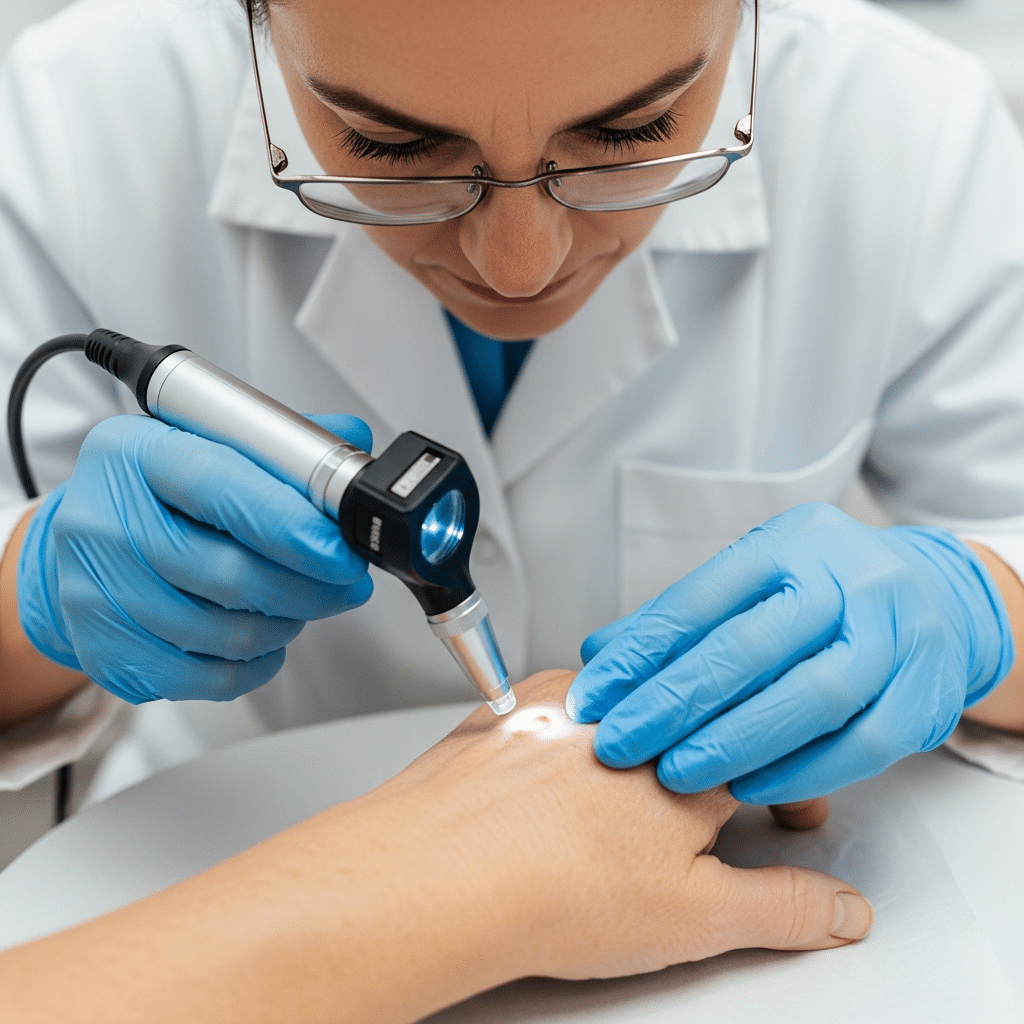
A layperson cannot reliably distinguish a harmless age spot from an early-stage malignant melanoma (black skin cancer). Any new or changing pigmentation, or any that is irregularly shaped or coloured, must be examined by a dermatologist. To do this, the doctor uses a special reflected-light microscope (dermatoscope) to assess the structure of the spot and rule out malignancy with certainty. Only once the specialist has given the all-clear should cosmetic treatment be considered.
Find out more about the medical background to various types of Pigment disorders Find out more in our main article.
Prevention: How to prevent new age spots
The best treatment is prevention. As age spots are a direct result of sun damage, consistent sun protection is by far the most effective measure.
Daily sun protection
Use a broad-spectrum sun cream with a high sun protection factor (SPF 30, or preferably 50) all year round on all exposed areas of skin, such as the face, neck, décolletage and the backs of your hands.
Avoid strong sunlight
Avoid the midday sun and take extra care to protect yourself by wearing suitable clothing and a hat.
Professional removal: A comparison of the 3 best methods
Once a dermatologist has confirmed that the spots are harmless, there are several effective methods of removal. All three procedures mentioned here are suitable for treating age spots, but each has its own advantages.
| Characteristic | Laser therapy | IPL technology | Chemical peel |
|---|---|---|---|
| Mechanism of action | High-energy light of a single wavelength | Broadband spectrum light | Chemical solution (acid) |
| Precision | Very high: highly precise treatment of individual stains | Method: Treatment of larger, extensive areas | Minor: extensive abrasion of the skin |
| Effectiveness | Very high; often only 1–2 sessions are needed | High; 2–4 sessions are usually required | That’s all well and good, but several sessions will be necessary |
| Ideal for | Clearly defined, isolated, dark patches | Extensive redness and pigmentation | General improvement in skin appearance and fine lines |
| Costs | Medium to high | Medium | Low to medium |
The methods in detail: laser, IPL and chemical peels
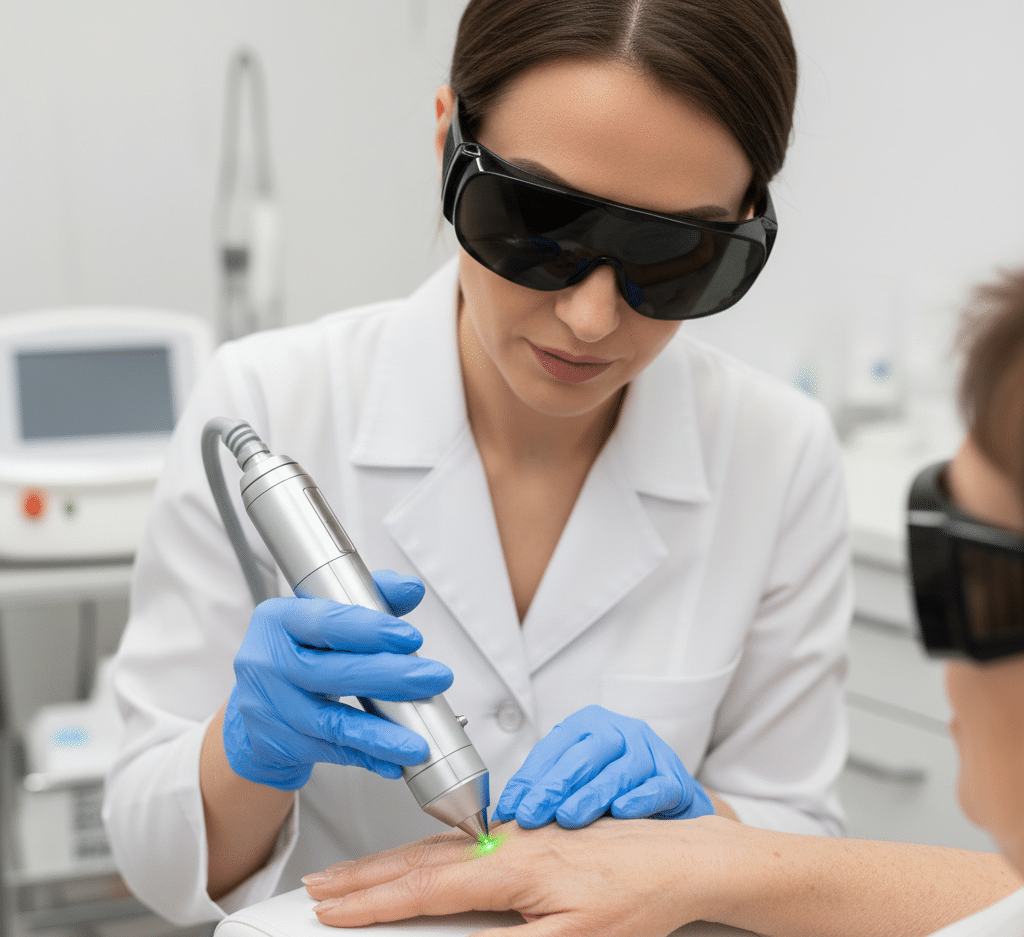
Laser therapy (e.g. ruby and alexandrite lasers): This is the gold standard for treating individual, clearly defined age spots. The laser beam can be directed at the spot with millimetre precision. It emits a short, high-energy light pulse which is selectively absorbed by the melanin in the age spot and converted into heat. This heat „breaks up“ the pigment clumps without damaging the surrounding, lighter skin. The broken-up pigment particles are cleared away by the immune system. After the treatment, a small scab forms, which falls off on its own after 5–10 days.
IPL (Intense Pulsed Light): IPL technology is ideal if you have several scattered age spots and possibly also sun-induced redness or fine broken capillaries across a larger area (e.g. the whole face, décolleté). The device emits light pulses across a broad wavelength spectrum, thereby treating a larger area than a laser. The light is also absorbed by the melanin in the age spots, causing them to break down. Several sessions are usually required to achieve the best possible results.
Chemical peel: Also TCA peel known as. In this procedure, an acid (e.g. trichloroacetic acid, TCA) is applied to the skin to exfoliate the outermost layers of the skin in a controlled manner. Along with the old skin cells, the pigment deposits are also removed. This method is less precise and is particularly suitable when, in addition to age spots, a general improvement in the skin’s appearance is desired.
Risks and the importance of follow-up costs insurance
Although these procedures are very safe when carried out by professionals, there are risks:
- Pigment changes: The treated area may become lighter (hypopigmentation) or darker (hyperpigmentation) than the surrounding skin.
- Infections: Particularly after laser or chemical peel treatments, when scabs form.
- Scarring: Very rare, but possible in the event of improper treatment or poor wound healing.
Should a complication arise that requires treatment, the costs of rectifying it often have to be borne by the patient. Insurance taken out prior to the procedure Consequential Costs Insurance can provide important financial security here.
Frequently Asked Questions (FAQ) about age spots
Age spots do not usually disappear on their own and are considered a permanent skin change, although their intensity may vary slightly.
The light pulses are often described as a brief, hot prick or like a rubber band snapping against the skin. The treatment is brief and is generally well tolerated without the need for anaesthetic.
Yes, an age spot that has been successfully removed does not usually reappear in the same place, but new spots may develop in the surrounding area.
The costs vary considerably. A laser or IPL session to treat a few spots starts at around €80–200. Treatments covering larger areas are more expensive.
In principle, all of them. The most common areas treated are the face, the backs of the hands, the forearms and the décolleté.