Asymmetry compensation
Asymmetry correction involves measures designed to harmonise visual imbalances between the two halves of the body or face, creating natural proportions.
Table of Contents
Important note
This article is for information purposes only and is not a substitute for a medical diagnosis or advice. If you are unsure, or if you require a personalised treatment plan, it is essential that you consult a qualified specialist.

Definition: What is an asymmetry adjustment?
A Asymmetry compensation In plastic and aesthetic surgery, this term refers to all medical procedures aimed at harmonising marked visual asymmetries between the two halves of the body or face.
The aim is not to create mathematically perfect symmetry, but to restore natural, unobtrusive proportions in order to alleviate the patient’s distress.
The causes: Why are we asymmetrical?
- Genetics & Growth: Natural, congenital differences in growth (e.g. uneven breast development during puberty).
- Traumas & Accidents: Scarring, broken bones or loss of tissue due to injuries.
- Diseases: Facial nerve palsy, scoliosis or tumour removal.
- Ageing process: Unilateral loss of volume or unilateral facial expressions (often caused by sleeping habits or chewing on one side).
Facial asymmetry: hyaluronic acid and Botox as a solution
Irregularities in the face (e.g. uneven lips, crooked noses, eyebrows at different heights) are particularly noticeable. In most cases, minimally invasive treatments are sufficient:
Hyaluronic acid (dermal filler):
The most important technique for correcting facial asymmetry. Hyaluronic acid can be used to even out uneven lip volume, visually straighten a crooked nose or restore volume to a sunken cheek on one side.
Botulinum toxin (Botox):
Used when muscle tension is causing the asymmetry. For example, if a muscle is pulling the eyebrow or the corner of the mouth down more on one side, botulinum toxin can specifically relax that muscle, thereby restoring visual balance to the face.
Breast asymmetry (anisomastia): Surgical solutions
Almost all women have a slight asymmetry in their breasts. However, if the difference is more than one cup size (anisomastia), patients often turn to plastic surgery. The choice of procedure is highly individual:
- Single-sided enlargement/reduction: Often, only the smaller breast is enlarged using an implant or the patient’s own fat, or the larger breast is reduced in size to match the other one.
- Combined procedures: In cases of severe asymmetry, a Breast augmentation (augmentation) and, on the other hand, a Breast lift (mastopexy) was performed.
Body asymmetries: When muscles and fat are unevenly distributed
Asymmetries in the legs, bottom or hips are often caused by uneven fat distribution or following accidents or operations.
- Lipofilling (autologous fat transfer): This is the gold standard method for the body. Fat is removed from areas where it is unwanted, processed and injected into asymmetrical or deficient areas (e.g. the calves or buttocks) to correct dimples or differences in volume.
Expectation management: The illusion of perfect symmetry
Perfection is unnatural
A reputable doctor will never promise you 100 per cent symmetry. Studies show that faces that are perfectly symmetrical are often perceived as unnatural or even eerie. Effective correction of asymmetry aims to Harmony . This means reducing the unevenness to such an extent that it no longer catches the eye of the observer (or your own in the mirror) in a distracting way.
Risks and complications: Why it is important to take out cover
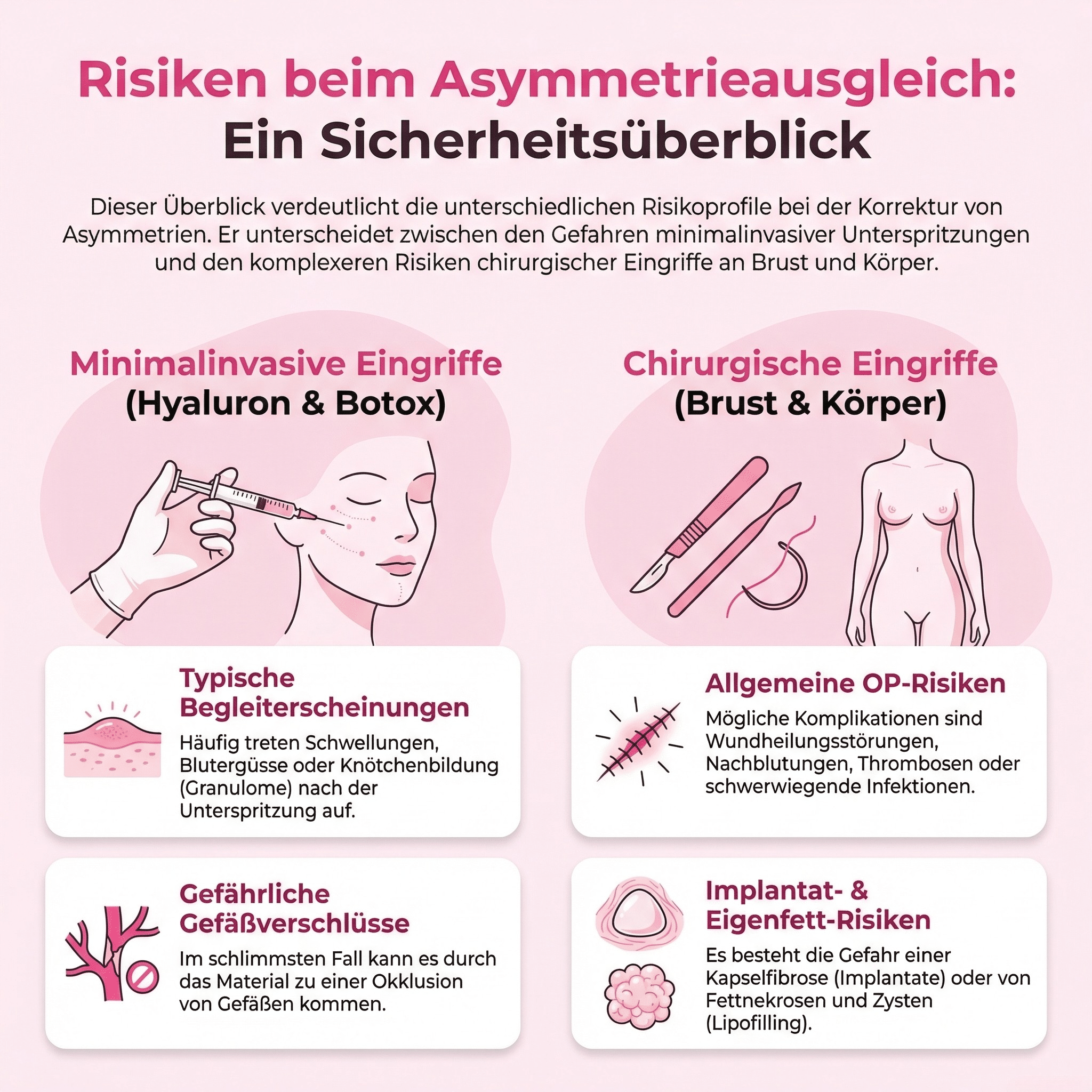
Regardless of whether the correction of asymmetry is carried out using a minimally invasive technique (using a syringe) or surgically (by operation), these are medical procedures that are never entirely risk-free.
Risks associated with minimally invasive procedures (hyaluronic acid/Botox)
Even though they may seem harmless, injections can cause swelling, bruising, the formation of nodules (granulomas) or, in the worst case, dangerous blockages of blood vessels (occlusions).
Risks associated with surgical procedures (breast/body)
Surgical procedures carry general risks such as impaired wound healing, post-operative bleeding, thrombosis or serious infections. The use of breast implants also carries a risk of capsular contracture. Autologous fat transfer (lipofilling) may lead to fat necrosis (the death of fat cells) or the formation of cysts.
Protection against unexpected follow-on costs
As correction of asymmetry is generally regarded as a cosmetic treatment for which there is no medical indication, your health insurance provider may, in accordance with Section 52(2) of Book V of the Social Code (SGB V), require you to contribute towards the cost of treatment in the event of complications.
The prior conclusion of a Consequential Costs Insurance It is therefore an essential safeguard to ensure that you are not left with high treatment costs in the event of unforeseen complications.
Frequently Asked Questions (FAQ)
If one side of the lips is noticeably narrower than the other, or if the lip contour is irregular following an accident or a cleft lip and palate. In such cases, hyaluronic acid can be used to sculpt the lips with precision.
For injections (Botox, hyaluronic acid), an anaesthetic cream is usually applied. Modern fillers also often contain a local anaesthetic (lidocaine), which makes the injection virtually painless.
The results are visible straight away, but they are not permanent. Depending on the material injected, your metabolism and the area treated (lips break down fillers more quickly than cheeks), the effect lasts for around 6 to 18 months.
If the asymmetry is caused by a unilateral muscular imbalance (e.g. in the face or arms), targeted physiotherapy exercises can help. However, exercise is of no help against asymmetries caused by bone structure, fat deposits or the skin.