Reputable plastic surgery: What to look for when choosing a good surgeon
Specialist qualifications, professional associations, transparent advice: How can you tell if a plastic surgeon is truly reputable – and which warning signs should you take seriously?

How to recognise a reputable plastic surgery clinic:
A reputable plastic surgeon holds the protected specialist title of „Specialist in Plastic and Aesthetic Surgery“, is a member of the DGÄPC or ISAPS, conducts a transparent consultation without any sales pressure, and works in a certified surgical environment.
Table of Contents
Important note
This article is for information purposes only and is not a substitute for a medical diagnosis or advice. If you are unsure, or if you require a personalised treatment plan, it is essential that you consult a qualified specialist.

For many people, cosmetic surgery fulfils a long-held wish. Whether it’s a nose job, liposuction or a breast lift — the number of cosmetic procedures is on the rise. According to ISAPS (International Society of Aesthetic Plastic Surgery), over 900,000 surgical and minimally invasive procedures were recorded in Germany alone.
As demand grows, so does the number of providers. This increases the risk of falling for dubious clinics. Choosing a reputable plastic surgery clinic is not a matter of gut feeling, but of applying the right criteria.
This guide explains which quality criteria really matter, which warning signs you need to be aware of, and which questions you should ask during your initial consultation.
5 qualities to look for in a reputable plastic surgeon
Reputable plastic surgery can be determined on the basis of specific, verifiable criteria. The following list summarises what you should bear in mind before undergoing any cosmetic surgery.
- Protected specialist title: „Specialist in Plastic and Aesthetic Surgery“
- Membership of the DGÄPC, DGPRÄC, ISAPS or VDÄPC
- A transparent consultation — in writing, without any time pressure
- Certified operating theatre environment with an emergency response plan
- Proven experience with the procedure in question and clear aftercare arrangements
Each of these criteria can be checked prior to the procedure. Anyone who meets all five is working in accordance with the standards set out in the plastic surgery are regarded as minimum requirements.
Checking specialist qualifications in plastic surgery: what the title really means
The term „cosmetic surgeon“ is not legally protected. Any registered doctor is entitled to use this title — regardless of their specialism or experience. The only legally protected title in Germany is „Specialist in Plastic and Aesthetic Surgery“. This qualification requires at least six years’ specialist training following a degree in medicine.
Experience shows that patients who are aware of this distinction are significantly less likely to use unqualified practitioners. You can check a doctor’s qualifications via the register of the relevant regional medical association. Alternatively, the DGÄPC (German Society for Plastic, Reconstructive and Aesthetic Surgery) offers a public doctor finder on its website. Doctors listed there have provided proof of their qualifications. They are trained in facial surgery, breast augmentation, liposuction, skin tightening and reconstructive procedures.

Warning signs: These signs point to dubious cosmetic surgery offers
Unscrupulous providers in the field of cosmetic surgery do not always operate in an obvious manner. Some warning signs only become apparent during the consultation. Others can be spotted if you take a close look at the clinic’s website.
| Warning signal | What it means |
|---|---|
| No verifiable specialist qualification | Lack of qualifications for surgical procedures |
| Limited-time discount offers | High-pressure sales — reputable practices do not use discounts as an incentive to buy |
| No written information session | Lack of legal protection for patients and doctors |
| Unclear emergency plan | No adequate safety protocol for complications |
| Outpatient procedures without a suitable operating theatre setting | Increased risk in the event of unforeseen incidents |
| No information on complication rates | A lack of transparency regarding realistic risks |
Particular caution is advised when it comes to offers that combine extremely low prices with extensive promises of results. Cosmetic surgery procedures — whether wrinkle treatment, nose surgery or anti-ageing medicine — require qualified staff, sterile operating theatres and a well-organised aftercare programme. These requirements come at a price.
Note
Botox and fillers are prescription-only medicines in Germany. Only registered doctors are permitted to administer them. Salons or beauty centres offering such treatments are in breach of the law.
Your first consultation with a plastic surgeon: questions you should ask a reputable surgeon
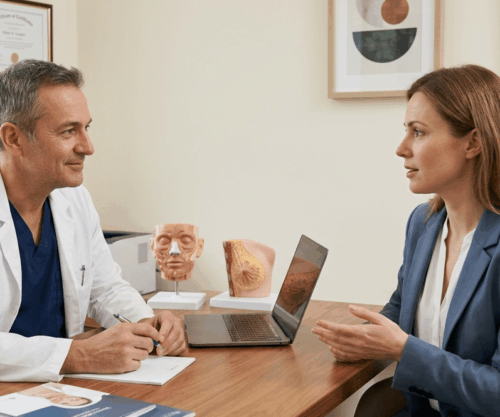
The initial consultation before cosmetic surgery is more than just a formality. Reputable cosmetic surgeons take the time to address your questions. They provide comprehensive answers to everything. And they do not make promises that are medically untenable. Make the most of this appointment.

Key points at a glance:
- How many procedures of this kind have you carried out in the last twelve months?
- What is your personal complication rate for this procedure?
- What happens if there are any problems after the procedure — who can be contacted and how?
- What are the arrangements for follow-up care, and how many follow-up appointments are included?
- Are there any situations in which you would refuse to carry out a procedure?
The last question is more revealing than it seems. A good plastic surgeon will refuse to carry out procedures if the patient’s expectations are unrealistic. He will also refuse if there are medical contraindications. Anyone who fulfils every wish unconditionally is not acting in the patient’s best interests.
You should also check whether the surgeon actively addresses psychological aspects. Realistic expectations are essential for satisfaction following any cosmetic procedure — whether it be liposuction, wrinkle treatment or Renuvion skin tightening.
Even if you choose carefully: what happens if complications arise
Even if you choose a qualified specialist who meets all the criteria mentioned, there is always a residual risk. Wound-healing complications, infections or capsular contracture following breast augmentation can occur even under optimal conditions. This is medically documented — it is not a sign of negligence.

The problem is the cost. Statutory health insurance does not cover the follow-up costs of cosmetic surgery. Anyone who needs revision surgery following, for example, a rhinoplasty or liposuction must pay for it entirely out of their own pocket. In the case of grade III or IV capsular contracture following breast surgery, the cost of replacing the implants can run to several thousand euros.
One Consequential Costs Insurance protects you from unexpected financial burdens in such cases. 4beauty offers specialised Insurance cover for plastic surgery procedures — tailored to the specific procedure and the associated risks. You can take out insurance cover online, even up to 24 hours before the procedure. Further information on frequently asked questions can be found in the FAQ section on 4beauty.
Frequently asked questions about reputable plastic surgery
The only protected specialist title is „Specialist in Plastic and Aesthetic Surgery“. It requires at least six years of specialist training following a degree in medicine.
Furthermore, membership of professional bodies such as the DGÄPC (German Society for Plastic, Reconstructive and Aesthetic Surgery), the DGPRÄC, the ISAPS or the VDÄPC is recognised as a mark of quality. The title „cosmetic surgeon“, on the other hand, is not protected by law.
You can check a doctor’s specialist status via the register of doctors maintained by the relevant regional medical association. Alternatively, the DGÄPC offers a public doctor-finding service on its website.
Enter the surgeon’s name and location. The doctors listed here have provided evidence of their qualifications. They are committed to meeting recognised quality standards.
Plastic surgery is the overarching speciality. It encompasses reconstructive procedures — for example, following accidents or cancer — as well as cosmetic procedures aimed at enhancing appearance.
Aesthetic surgery refers to the branch of surgery that focuses exclusively on cosmetic improvements: liposuction, hair transplants, breast augmentation, wrinkle treatment and similar procedures. A specialist in plastic and aesthetic surgery is trained in both areas.
Statutory health insurance funds do not, as a rule, reimburse follow-up costs arising from purely cosmetic procedures. According to the Federal Ministry of Health, the following applies: anyone who undergoes surgery for purely aesthetic reasons must bear the full cost themselves — including any medically necessary follow-up treatment.
If complications arise, you will have to pay for revision surgery, hospital stays and further treatment yourself. Specialist insurance covering follow-up costs bridges this gap. For many procedures, it is available from 35 euros a year.
Minimally invasive procedures include treatments such as Botox injections, filler treatments, laser treatments and anti-ageing medicine. These procedures do not require open surgery.
As Botox is classified as a prescription-only medicine in Germany, these procedures may only be carried out by registered doctors. Salons or beauty centres without a medical licence are acting unlawfully — even though such services are widely advertised on the internet.
Tick off the points before you make your final choice of surgeon. All 7 points should be met.
Checklist: Is your surgeon really reputable?
- The title of specialist is protected: The doctor holds the title of „Specialist in Plastic and Aesthetic Surgery“ — not an unprotected marketing term such as „cosmetic surgeon“.
- Membership of a recognised professional body: Proof of membership of the DGÄPC, DGPRÄC, ISAPS or VDÄPC is clearly set out.
- A transparent, non-pressurising consultation: Risks, alternatives and realistic outcomes are communicated openly and in writing — without any sales pressure.
- Proven experience with the planned procedure: The surgeon can provide statistics on the number of cases, reference photographs or patient testimonials relating to the specific procedure.
- A clear approach to aftercare and complications: The doctor explains how emergencies and follow-up cases are handled and who can be contacted in the event of an emergency.
- The procedure takes place at a certified facility: The operation is carried out in an approved surgical centre or a specialist clinic — not in an uncertified setting.
- No unrealistic promises or aggressive discount campaigns: Reputable providers do not advertise with permanent special offers or guaranteed results.
5 Qualitätsmerkmale, die einen seriösen plastischen Chirurgen auszeichnen. Stand: Juli 2026.
You might also be interested in this
-
Preparation & Aftercare
Was viele Patienten unterschätzen: Die psychische Seite ästhetischer Eingriffe
Bei Schönheitsoperationen stehen meist Methoden, Risiken und Kosten im Fokus. Doch die psychische Seite ästhetischer Eingriffe wird oft unterschätzt – mit weitreichenden Folgen für Patienten.
-

Treatments
Tummy Tuck: Everything You Need to Know at a Glance
A toned tummy, a new-found confidence – but which method is right for you, what does the recovery process involve, and what costs can you expect? All the key answers at a glance.
-

Risks & Complications
Buttock Augmentation: Risks and Complications – Your Comprehensive Guide to Making an Informed Decision
Many people dream of having a shapely bottom – but bottom augmentation is also a matter of safety. What risks and complications should you be aware of beforehand?
-

Treatments
Male genital cosmetic procedures – methods, costs and risks of intimate surgery explained in simple terms
More and more men are finding out about genital cosmetic procedures – which involve far more than just penis enlargement. We provide honest information about the methods, procedures, risks and costs.
-

Treatments
Eyelid Lift: The Comprehensive Guide
Drooping eyelids can make your eyes look tired. Find out what treatment options are available, what aftercare involves, and what risks and costs you should bear in mind.
-

Risks & Complications
Upper Arm Lift Risks and Complications: The Honest and Comprehensive Guide to Making a Safe Decision
Toned upper arms and greater confidence when wearing sleeveless clothes – but an upper arm lift is not a risk-free procedure. What complications should you be aware of beforehand?