Ablation (ablative)
In aesthetic dermatology, ablation refers to a method of skin renewal that is primarily used in laser treatments.
In modern aesthetic dermatology, the term Ablation is of central importance in understanding the intensity and mechanism of action of skin-renewal treatments. It describes a powerful medical principle that is applied in certain procedures, particularly laser therapies.
This article explains, in a clear and concise manner, what „ablation“ means in a cosmetic context, how ablative procedures differ from non-ablative ones, and for which skin problems this method is used.
Table of Contents
Important note
This article is for information purposes only and is not a substitute for a medical diagnosis or advice. If you are unsure, or if you require a personalised treatment plan, it is essential that you consult a qualified specialist.
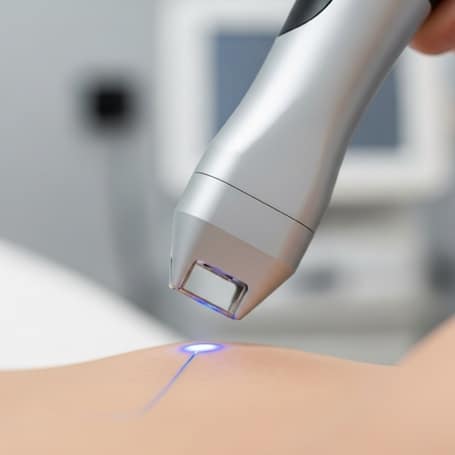
What does ‘ablation’ mean? A definition
The term Ablation (from Latin ablatio = Ablation, exfoliation) refers, in aesthetic medicine, to the targeted, layer-by-layer removal of tissue. In a dermatological context, it refers to the removal of the outermost layer of skin (the epidermis) and – depending on the procedure – also parts of the upper dermis. The aim is to remove damaged areas of skin and to stimulate deep regeneration and the formation of new, healthy, smooth skin.
The key principle: ablative vs. non-ablative
Modern aesthetic skin treatments can be divided into two basic categories. Understanding this difference is key to choosing the right treatment.
Ablative procedures: These methods work from the „outside in“. They physically abrade the skin’s surface in order to reach deeper layers. This results in an open wound that takes time to heal, but also produces the most significant and visible results in terms of skin renewal.
Non-ablative procedures: Non-ablative procedures leave the skin’s surface intact and primarily act within the dermis (e.g. through targeted heating) to stimulate new collagen formation there. The results are more subtle and the downtime is minimal.
| Criterion | Ablative procedures | Non-ablative procedures |
|---|---|---|
| Mechanism of action | Removal of the skin’s surface (epidermis) | Heating of the deeper layers (dermis) |
| skin surface | It has been deliberately injured and needs to heal again | Remains intact |
| Results | Strong and clearly visible; a massive improvement in texture | Subtle and gradual; primarily streamlining |
| Downtime | Significant (7–14 days with redness and scabs) | Minimal to none (slight redness) |
| Areas of application | Deep wrinkles, severe sun damage, acne scars | Mild sagging of the skin, fine lines, prevention |
| Examples | CO₂ laser, erbium:YAG laser, highly concentrated TCA peel | Radio frequency, ultrasound, many IPL systems |
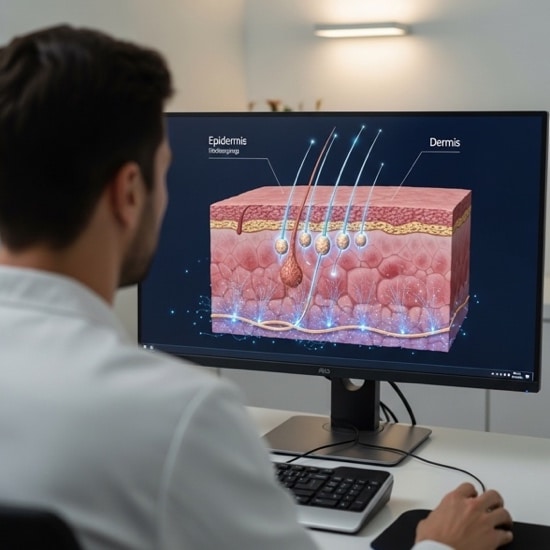
The modern evolution: Fractional ablation
In the past, ablative laser treatment involved the complete removal of the skin across the entire treatment area. This was associated with very long recovery times and high risks.
The standard technology used today is the fractional ablation. In this procedure, the laser creates thousands of microscopically fine channels in the skin, whilst leaving small „bridges“ of untreated, healthy skin between them. Wound healing takes place much more quickly and safely from these bridges. This principle enables the high effectiveness of an ablative treatment whilst significantly reducing downtime and minimising risks.
Areas of application and risks
Ablative procedures are the treatment of choice for advanced skin conditions:
Typical indications: Deep wrinkles (e.g. around the mouth), pronounced acne scars, severe sun damage, sagging skin, some forms of Scar treatment.
Risks: Due to the intensity of the treatment, the risks are higher than with gentler methods. These include:
- long-lasting redness
- Infections
- Scarring and
- Pigment changes (light or dark patches), particularly if the treatment is not used correctly or if insufficient sun protection is used after the treatment.
The complexity and the risks make it clear why ablative treatments must only be carried out by experienced doctors. A Consequential Costs Insurance provides financial security should complications arise following the procedure that require extensive medical aftercare.
Frequently Asked Questions (FAQ) about ablation
The CO₂ laser is regarded as the ablative laser with the deepest penetration and highest intensity in aesthetic dermatology; it produces the most impressive results, but also entails the longest healing time. The erbium:YAG laser is also ablative, but is somewhat gentler and involves a shorter recovery time.
Yes. Ablative laser treatment requires effective pain relief, for example through a strong anaesthetic cream, a local anaesthetic or twilight sedation.
Immediately after treatment, the skin is red, swollen and oozing. Over the following days, scabs form, which fall off after about 7–10 days. Beneath them, new, pink skin appears.
The single most important factor for a complication-free recovery and a good outcome is a meticulous, consistent use of sun cream (SPF 50+) for at least 3 to 6 months, to prevent pigment changes.