Columella
The columella, known in German as the ‘nasal bridge’, is the vertical bridge of skin and cartilage between the two nostrils, connecting the tip of the nose to the upper lip.
Table of Contents
Important note
This article is for information purposes only and is not a substitute for a medical diagnosis or advice. If you are unsure, or if you require a personalised treatment plan, it is essential that you consult a qualified specialist.
The Columella (Latin for „small column“), also known in German as nose bridge is the vertical bridge of skin and cartilage that separates the two nostrils (nares). It forms the anterior, lower part of the nasal septum (septum nasi) and connects the tip of the nose to the upper lip. Anatomically, it consists of skin, subcutaneous tissue and the medial legs of the paired alar cartilages (crura mediales of the cartilagines alares majores).
Objective From an aesthetic perspective, the columella should blend harmoniously into the overall appearance of the nose and face. When viewed from the side, it should be visible just below the edge of the nostrils (the so-called „columella show“) and form an aesthetically pleasing nasolabial angle (the angle between the columella and the upper lip).
Indications
Deviations from the ideal shape and position of the columella can adversely affect the aesthetic appearance of the nose and may warrant corrective treatment. Common aesthetic „indications“ or variations in shape that are perceived as unsightly include:
- Hanging Columella (Hanging Columella / Columellar Show): The bridge of the nose is excessively visible from the side or from the front and hangs lower than the nostrils. This can make the nose appear longer or the tip of the nose appear to „droop“.
- Retracted columella: The bridge of the nose is too short or turns inwards, and is barely visible – or not at all – when viewed from the side. This can make the upper lip appear shorter and give the tip of the nose a blunt appearance.
- Width of the columella: The bridge of the nose looks too wide when viewed from the front.
- Crooked or deviated columella: The bridge of the nose does not run straight along the midline; this is often associated with a deviation of the entire nasal septum.
- Disproportionate nasolabial angle: An angle that is too acute or too obtuse between the bridge of the nose and the upper lip.
These variations in shape may be congenital or may result from injuries or previous nasal surgery.
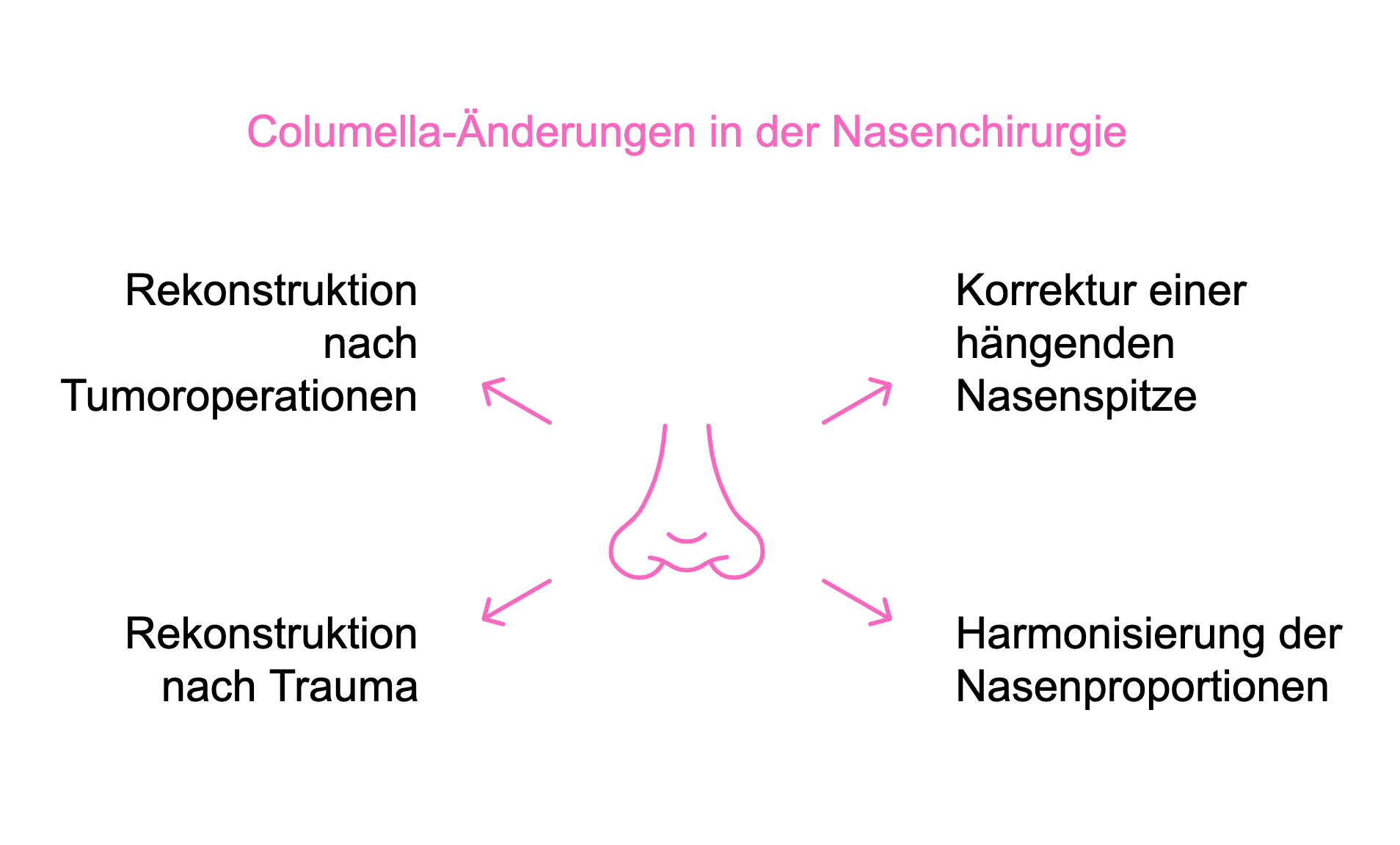
Surgery (options for correcting the columella)
Corrections to the columella are usually carried out as part of a Rhinoplasty (nose reshaping). This is rarely a stand-alone procedure, as the columella is closely linked to the structure of the tip of the nose and the nasal septum. The specific technique depends on the type of deformity:
- In the case of a drooping columella: Excess cartilage and/or skin from the columella can be removed. Sometimes the attachment of the medial alar cartilages is also modified.
- In the case of a retracted columella: Cartilage grafts (often taken from the nasal septum or the ear) can be used to lengthen, support and lower the columella (known as a columella strut or septal extension graft).
- If the columella is wide: The medial wing cartilages can be narrowed and repositioned.
- In the case of a deviated columella: This often requires correction of the entire nasal septum (septorhinoplasty).
In very select cases involving minor contour irregularities, minimally invasive methods such as the injection of hyaluronic acid fillers may be considered; however, these do not address structural problems.
The procedure for columella correction as part of rhinoplasty
The columella correction procedure forms part of the overall rhinoplasty process:
- Pre-operative phase In-depth consultation, analysis of the shape of the nose and the position of the columella, photographic documentation, explanation of the objectives, techniques and risks. Planning of the procedure.
- Anaesthesia Rhinoplasty procedures involving columella modification are usually performed in General anaesthesia carried out.
- Surgical techniques Open rhinoplasty: This involves making a small incision in the columella itself (a transcolumellar incision, often referred to as an inverted V or stepped incision), as well as incisions inside the nostrils. This provides a direct view and allows for precise manipulation of the cartilaginous structures of the tip of the nose and the columella. Closed rhinoplasty: All incisions are made inside the nose. The columella structures are also accessible via this route, although direct visual access is more limited. The surgeon then reshapes the cartilage of the columella, removing excess tissue or adding supportive material.
- Wound closure The incisions are closed with fine stitches. The nose is often stabilised with a plaster cast or a plastic splint.
Scarring following columella surgery
- Open rhinoplasty: It leaves a small, fine scar on the columella. Provided the incision is made correctly and the wound heals well, this scar is usually very inconspicuous and barely visible after a few months.
- Closed rhinoplasty: There are no external scars on the columella, as all incisions are made internally. Individual scar healing depends on various factors, including skin type and genetic predisposition. Careful scar aftercare once the wound has healed can improve the appearance of the scar.
Aftercare following columella corrections
Aftercare is essentially the same as that following a nose job:
- Cooling and elevated storage of the upper body to reduce swelling.
- Nasal splint/plaster cast for about 1–2 weeks.
- Nose care using decongestant sprays or ointments as directed.
- Avoiding pressure on the nose (e.g. glasses, blowing your nose).
- Taking it easy physically, avoiding sport for several weeks.
Recovery time following the procedure
- Social skills: Often after about two weeks, once the worst of the swelling and bruising has subsided and the plaster cast has been removed.
- Decongestion: The nose, including the columella, will continue to shrink over several months. The final result of a rhinoplasty can often only be fully assessed after 6–12 months or longer.
Coverage of the costs of columella corrections
Corrections to the columella as part of cosmetic rhinoplasty are usually not covered by statutory or private health insurance. The costs form part of the total cost of the rhinoplasty.
Only if a malposition of the columella forms part of a medically indicated nasal operation (e.g. in the case of severe functional impairment of nasal breathing caused by a deviated septum that also affects the columella, or in the case of reconstructive surgery following accidents), can a partial reimbursement of costs be considered.
For purely cosmetic procedures, it is advisable to find out about a Consequential Costs Insurance, which can cover any costs for medically necessary follow-up treatment in the event of complications.