General anaesthesia, twilight sedation or local anaesthesia: which type of anaesthesia is appropriate in which situation?
General anaesthesia, twilight sleep or local anaesthesia – which type of anaesthesia is suitable for which procedure? An overview of the effects, risks and the right choice for your treatment.

General anaesthesia, twilight sleep or local anaesthesia:
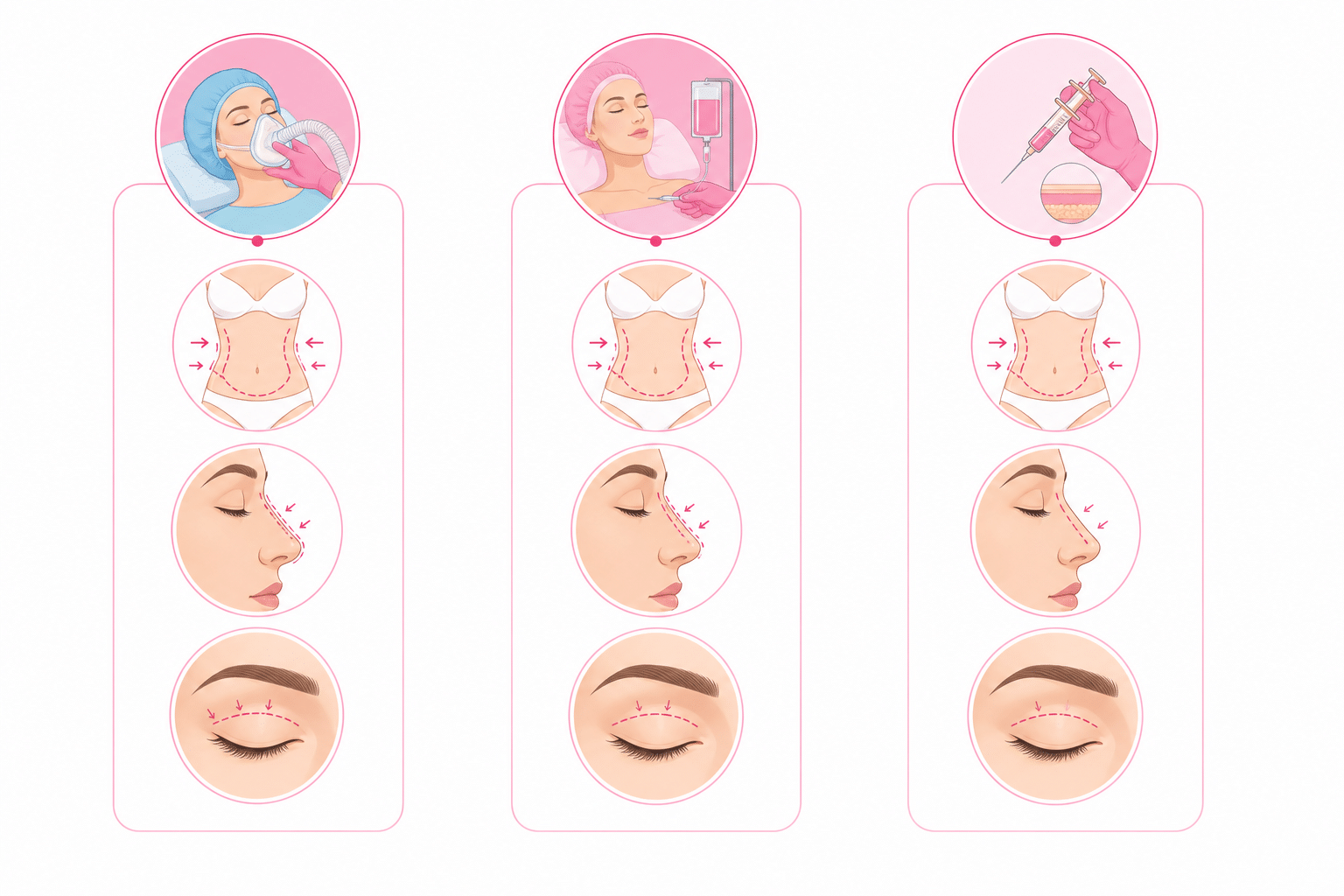
General anaesthesia completely suppresses consciousness and spontaneous breathing. Twilight sleep (analgosedation) allows the patient to continue breathing spontaneously whilst in a state of deep relaxation. Local anaesthesia numbs only a limited area of the body; the patient remains awake.
Table of Contents
Important note
This article is for information purposes only and is not a substitute for a medical diagnosis or advice. If you are unsure, or if you require a personalised treatment plan, it is essential that you consult a qualified specialist.
Anyone planning cosmetic surgery is faced early on with the question of which anaesthetic method is most suitable. The choice depends on the extent of the procedure, the patient’s personal state of health and — a factor that is often underestimated — the risk of complications, which has a direct impact on financial planning.

An overview of the three anaesthetic techniques
Key points at a glance
- General anaesthesia: Unconscious, on artificial ventilation, anaesthetist required to be present
- Twilight sleep: Maintenance of spontaneous breathing, deep relaxation, intravenous sedation via a venous line
- Local anaesthesia: Local anaesthesia, patient awake, low-risk profile
General anaesthesia
General anaesthesia is the most comprehensive form of anaesthesia. Three classes of active substances work together: a hypnotic (sleeping aid), an opioid to block pain, and a muscle relaxant. The body enters a controlled state of deep sleep. As protective reflexes are suspended, a ventilator takes over the function of breathing. A specialist in anaesthesiology monitors the entire procedure.
Before the procedure, the anaesthesia team establishes a venous access, usually on the back of the hand. The anaesthetic takes effect within seconds. After the procedure, the medication is gradually reduced and the patient is brought round under controlled conditions. In accordance with the recommendations of the German Society for Anaesthesiology and Intensive Care Medicine (DGAI), patients must refrain from eating solid food for several hours before anaesthesia. Clear liquids are permitted up to about two hours beforehand.
Twilight sleep (analgosedation)
Twilight sleep — medically known as analgosedation or sedation — is not a light anaesthetic, but a deep state of relaxation. Sedatives and analgesics are administered intravenously via a venous access. The key difference from general anaesthesia is that the patient continues to breathe unaided; a ventilator is not required. Patients have no memory of the treatment after the procedure. A specially trained doctor monitors cardiovascular function at all times.
Local anaesthesia (local anaesthetic)
Local anaesthesia numbs a clearly defined area of the body through the targeted injection of an anaesthetic directly into the tissue. The patient remains fully awake and responsive. Neither consciousness nor spontaneous breathing is affected. An anaesthetist is not strictly necessary. Local anaesthesia is the lowest-risk of the three procedures — it is restricted to minor and superficial procedures.
| Characteristic | General anaesthesia | Twilight sleep | Local anaesthesia |
|---|---|---|---|
| Awareness | Completely switched off | Very faint, no recollection | Fully preserved |
| Spontaneous breathing | No (ventilation required) | Yes | Yes |
| Anaesthetist | Obligation | Required | Not mandatory |
| Recovery time | 6–24 hours | 2–6 hours | A few hours |
Which procedure is used for which operation?
The anaesthetist decides, in consultation with the patient, which method to use. This decision is based on the extent of the procedure and the patient’s individual state of health. The patient’s own preferences are taken into account, provided this is medically justifiable.
- General anaesthesia It is used in extensive cosmetic surgery — such as tummy tucks, major liposuction procedures or breast surgery involving implants. These procedures require the muscles to be completely relaxed.
- Twilight sleep It is recommended for moderate procedures such as rhinoplasty or eyelid lifts. Experience shows that anxious patients opt for this procedure because it requires neither general anaesthesia nor mechanical ventilation. The procedure can be carried out on an outpatient basis; a companion is required to accompany the patient home.
- Local anaesthesia is sufficient for minor, superficial corrections that do not require access to deep tissue.
Contraindications: Who is unsuitable for which procedure?
Contraindications determine which procedure is ruled out — before the surgeon even begins the planning process. The pre-operative consultation serves precisely this purpose.
- General anaesthesia: Patients with severe heart failure, unstable coronary heart disease or severe lung disease are at increased risk during anaesthesia. It is also essential to inform the doctor of any known allergies to anaesthetics or a personal or family history of malignant hyperthermia — a rare but life-threatening muscular reaction.
- Twilight sleep: Severe sleep apnoea, serious respiratory conditions or known hypersensitivity to benzodiazepines and opioids restrict its use. Severely obese patients require particularly careful monitoring of respiratory function.
- Local anaesthesia: Coagulation disorders or ongoing anticoagulant therapy may increase the risk of bleeding at the injection site. Any known allergies to local anaesthetics, such as lidocaine, must be clarified before the procedure.
Important note:
This overview is no substitute for a consultation with a doctor. Any pre-existing conditions, current medication and individual risk factors must be fully disclosed so that the anaesthetist can select the safest procedure.
Risks and common side effects
All established anaesthetic procedures are safe in Germany — yet complications can still occur. Typical side effects of general anaesthesia include nausea and dizziness after waking up; these occur in around 20–30 % of patients. With analgosedation, allergic reactions to sedatives are possible. Local anaesthetics can, in rare cases, lead to circulatory reactions.
Wound-healing complications, infections and follow-up operations are not uncommon after cosmetic surgery — regardless of the anaesthetic method chosen. Patients are responsible for these additional costs themselves, as statutory health insurance schemes do not reimburse them.
Financial protection in the event of complications following cosmetic surgery
Complications arising from cosmetic surgery are not covered by statutory health insurance. Wound revisions, hospital stays or medically necessary corrective procedures are entirely at the patient’s expense. The Consequential Costs Insurance 4beauty covers precisely these risks — from wound revisions to corrective procedures, with cover of up to 300,000 euros.

Note:
Twilight sleep is not covered by statutory health insurance schemes. With private health insurance, coverage depends on the terms of your individual policy. Please check this with your insurer before the procedure.
You can find out more about the procedures covered and the premiums in the overview of all insured procedures, as well as in the frequently asked questions about follow-up costs insurance. You can take out the insurance up to 24 hours before the procedure — directly online at 4beauty.
Frequently asked questions about anaesthesia methods used in cosmetic surgery
The key difference lies in spontaneous breathing: during twilight sleep, you breathe on your own, whereas under general anaesthesia, a ventilator takes over this function. During twilight sleep, you remain in a deep but not completely unconscious state — although an anaesthetist monitors both procedures at all times.
Yes. Twilight sleep is a well-established, safe procedure provided that a qualified doctor continuously monitors cardiovascular function. As with any form of anaesthesia, side effects may occur, but the incidence of serious complications is low.
General anaesthesia is recommended for more extensive liposuction procedures, as significant muscle relaxation is required. A rhinoplasty can be carried out successfully under twilight anaesthesia, which allows for shorter recovery times. The final decision is made by the anaesthetist in consultation with the surgeon, based on your state of health.
The requirement to fast is for safety reasons: if your stomach is full, there is a risk that stomach contents could enter the lungs and cause severe inflammation. You must avoid solid food for several hours before the procedure. Clear liquids are permitted up to about two hours beforehand.
Statutory health insurance schemes do not cover the costs of twilight anaesthesia for cosmetic surgery. Private health insurance schemes may cover the costs either in part or in full, depending on the policy — it is advisable to clarify this before the procedure.
You might also be interested in this
-
Treatments
Everything you need to know about ear correction (otopexy, otoplasty)
Protruding ears are not uncommon, but many people are self-conscious about them. Find out here how an otopexy is carried out, how much it costs and what risks are involved.
-

Treatments
Tummy Tuck: Everything You Need to Know at a Glance
A toned tummy, a new-found confidence – but which method is right for you, what does the recovery process involve, and what costs can you expect? All the key answers at a glance.
-

Treatments
Everything you need to know about a forehead lift: techniques, aftercare, costs and risks
Tired-looking eyes, drooping eyebrows, deep wrinkles? A forehead lift can visibly rejuvenate your appearance. Find out what methods are available and what you need to bear in mind regarding aftercare and costs.
-

Costs & Insurance
How much does cosmetic surgery really cost? Total costs, follow-up costs and financial risks
The price quoted by the surgeon rarely covers the actual costs of cosmetic surgery. Anaesthesia, aftercare and any complications can drive the price up considerably.
-

Preparation & Aftercare
Aftercare following cosmetic surgery: What really matters for healing and results after the procedure
Surgery is only the first step – aftercare determines the final outcome. Here’s what you absolutely must do correctly in the first few weeks.
-

Treatments
Eyelid Lift: The Comprehensive Guide
Drooping eyelids can make your eyes look tired. Find out what treatment options are available, what aftercare involves, and what risks and costs you should bear in mind.