Aftercare
Aftercare refers to the post-operative care period; how you look after yourself in the first few days and weeks following the procedure will influence wound healing and scar formation.
A successful cosmetic operation does not end with the last stitch in the operating theatre. The crucial phase for a good-looking, complication-free result begins immediately afterwards: the Aftercare, in German the post-operative aftercare. Your behaviour in the first few days and weeks following the procedure has a huge impact on wound healing, scarring and the overall success of your treatment.
This guide is designed to be your all-round companion for the period following your operation. We explain the golden rules of post-operative care and why they are so crucial to your safety.
Table of Contents
Important note
This article is for information purposes only and is not a substitute for a medical diagnosis or advice. If you are unsure, or if you require a personalised treatment plan, it is essential that you consult a qualified specialist.

Definition: What does ‘aftercare’ mean?
Aftercare (post-operative care) encompasses all measures and guidelines that are followed after a surgical procedure to support wound healing, prevent complications and ensure a successful outcome.
It is a joint effort between your surgeon, who is responsible for your medical care, and you, the patient, who plays an active part in the healing process by following the instructions carefully.
The 5 pillars of post-operative aftercare
Every procedure has its own specific instructions, but these five key principles apply universally:
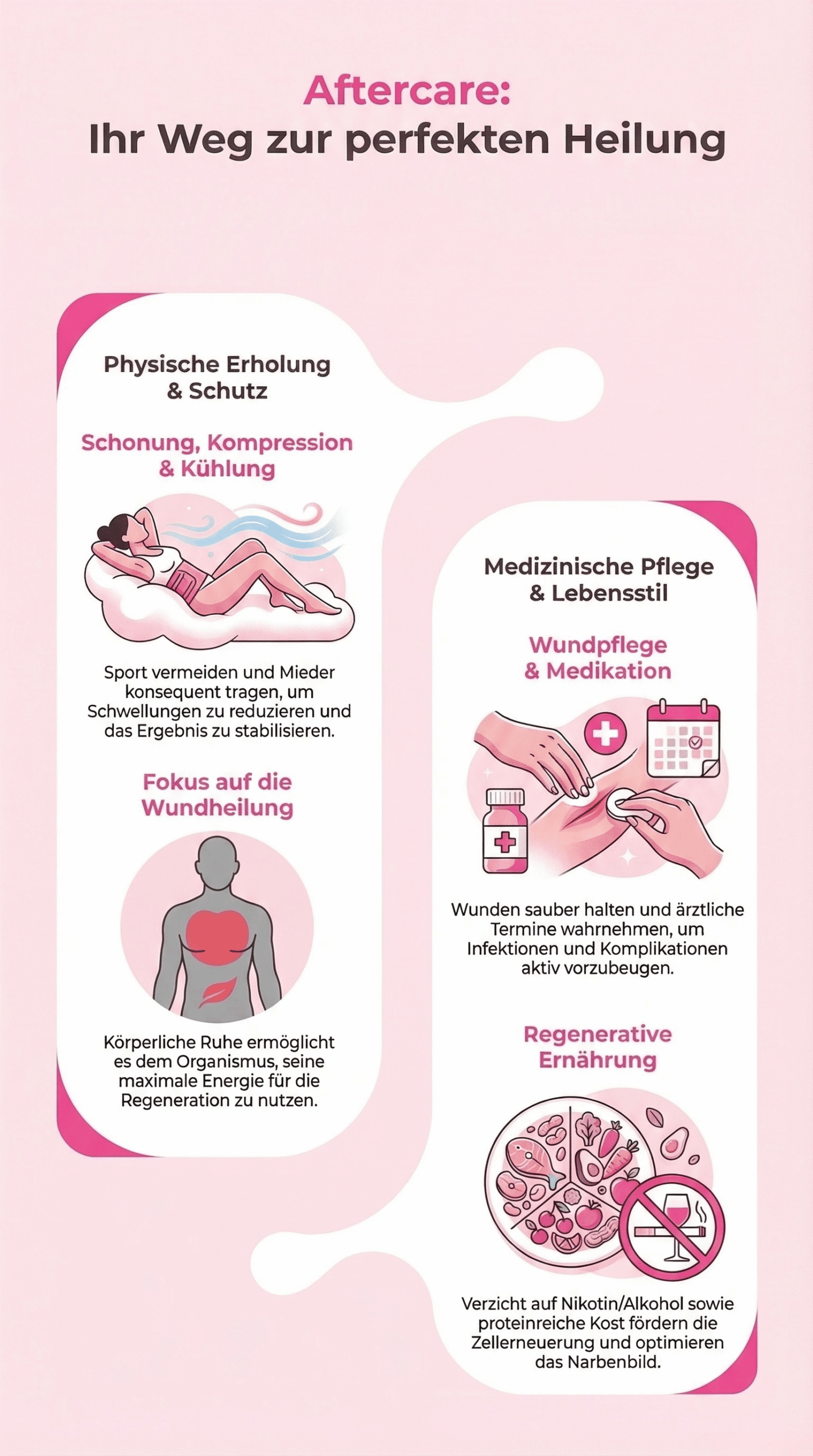
- Physical rest and recuperation: Your body needs all its energy to heal. It is essential that you avoid lifting, bending over, stretching and sporting activities during the first few weeks. Make sure you get enough sleep and allow yourself plenty of rest.
- Compression & Cooling: Compression garments (girdles, bras, belts) reduce swelling, prevent bruising (haematomas) and support the new shape. Consistent application of cold compresses during the first 48–72 hours minimises swelling and pain.
- Wound and scar care: Keep wound dressings clean and dry. Do not start scar care (massaging, silicone ointments) until the wound has completely healed and you have consulted your doctor (usually after 2–3 weeks).
- Taking medication & follow-up appointments: Take any prescribed medication (painkillers, antibiotics) exactly as instructed. Make sure you attend all your follow-up appointments with your surgeon – even if you feel well.
- Healthy lifestyle: You must strictly avoid nicotine and alcohol, as both significantly impair wound healing. A diet rich in protein and vitamins, combined with sufficient fluid intake, helps the body to recover.
Preparing for post-operative care: your home as an oasis of calm
Good aftercare starts right from the start before the operation. By preparing your home for the recovery period, you can reduce stress and provide your body with the best possible support.
- Pre-cooking & Shopping: Make sure you have a supply of easily digestible, protein-rich meals and plenty of drinks (water, tea) for the first few days after the operation.
- Creating a comfortable environment: Place everything you need (medication, water, phone, books) within easy reach of your bed or sofa. Avoid having to stretch or get up.
- Organising help: Ask a partner, friend or family member to look after you for the first 24–48 hours. You will need help getting up or with everyday tasks.
- Comfortable clothing: Have loose, comfortable clothing ready (e.g. loose-fitting jogging bottoms, button-up shirts rather than T-shirts) that does not put pressure on the wounds and is easy to put on and take off.
„Red flags“: When should I contact my doctor straight away?
Mild pain, swelling and bruising are normal. However, if you experience any of the following symptoms, you should contact your surgeon or go to A&E immediately:
Warning signs of complications:
- Fever above 38.5 °C
- Severe, throbbing, one-sided pain, which do not respond to painkillers
- Increasing, firm swelling in a particular part of the body
- Severe redness, excessive warmth or pus from the wound
- Sudden shortness of breath or chest pain (may indicate an embolism!)
The role of follow-on costs insurance
Despite a perfect operation and careful aftercare, complications may arise that require further medical treatment or even corrective surgery. These may include wound-healing problems, infections or aesthetically unsatisfactory results such as a Capsular fibrosis be.
As statutory and private health insurance schemes do not usually cover the costs of such follow-up treatment after cosmetic procedures, patients are left with a financial shortfall. A Consequential Costs Insurance covers precisely this risk and ensures that you are financially protected in the event of a complication.
Frequently Asked Questions (FAQ) on Aftercare
That depends on the type of dressing. It is often possible to have a shower after just 2–3 days if you are using special waterproof plasters. Please be sure to ask your doctor about this.
Usually over several weeks, often 4 to 6 weeks, and generally day and night at the start – your surgeon will determine the exact duration depending on the procedure. This is one of the most important factors in achieving a good result.
Light activities such as going for a walk are often permitted after just a few days. You will usually need to avoid strenuous exercise that significantly increases your heart rate or puts strain on the area that has been operated on for at least 6 weeks.
Once the wound has completely healed, regular, gentle massages using ointments containing oil or special silicone gels can help. However, the most important factor is to apply sun protection (SPF 50+) consistently to the scars for at least 12 months to prevent dark discolouration.
A reputable surgeon will always give you a personal emergency mobile number to use for the first 24–48 hours after the operation. Make sure you clarify this before the operation! If, however, you are unable to contact them and experience any of the „red flag“ symptoms mentioned above (such as sudden shortness of breath or extreme pain), do not hesitate for a second: call the emergency services (112) or go to the A&E department of the nearest hospital. Your immediate health is the absolute priority.