Information on anaesthesia: What patients need to know before cosmetic surgery
The anaesthesia briefing is the legally required discussion regarding anaesthetic procedures, risks and alternatives, and forms the basis for consent under Section 630e of the German Civil Code (BGB).
Information on anaesthesia
The anaesthesia consultation is the legally required discussion between the anaesthetist and the patient prior to a surgical procedure, during which the patient is informed about the planned anaesthetic technique, potential risks and alternatives; it forms the basis for legally valid consent in accordance with Section 630e of the German Civil Code (BGB).
Table of Contents
Important note
This article is for information purposes only and is not a substitute for a medical diagnosis or advice. If you are unsure, or if you require a personalised treatment plan, it is essential that you consult a qualified specialist.
Anyone planning cosmetic surgery faces the anaesthesia consultation – a mandatory appointment that is more than just a formality. The consultation safeguards the patient’s right to self-determination and provides the anaesthetist with the medical basis for selecting the appropriate anaesthetic technique. Anyone who knows what will be discussed during this consultation and what questions they should ask will make more informed decisions and feel more relaxed going into the procedure.

What is anaesthesia counselling: definition and legal basis
Key points
- Anaesthetic counselling is the mandatory provision of information to the patient regarding anaesthetic procedures, risks and alternatives prior to a surgical procedure.
- The duty to provide information is set out in Section 630e of the German Civil Code (BGB) (Patient Rights Act 2013).
- Without the patient’s valid consent, any medical intervention is legally regarded as bodily harm.
- The consultation is conducted by a specialist in anaesthesiology, separately from the pre-operative consultation with the surgeon.
The Information on anaesthesia, also known as an anaesthesia briefing or pre-anaesthesia consultation, is not a mere bureaucratic formality, but a discussion of central medical and legal importance. The Patient Rights Act, which came into force in Germany in 2013 and is codified in Section 630e of the German Civil Code (BGB), obliges doctors to provide patients with comprehensive, understandable and timely information. Every operation, whether carried out in a hospital or on an outpatient basis, requires the patient’s explicit consent.
Particularly in the case of cosmetic procedures that patients fund entirely privately, the pre-anaesthesia consultation takes on an additional dimension: those who are aware of the risks can also realistically assess the financial consequences of any potential complications. The consultation therefore covers not only medical information but also, implicitly, information of financial relevance.
Who conducts the pre-anaesthesia briefing?
The pre-anaesthesia consultation is conducted exclusively by a specialist in anaesthesiology, not by the operating surgeon. This separation is deliberately intended for both medical and legal reasons: the anaesthetist assesses the patient’s suitability for anaesthesia independently of the surgical procedure. Experience shows that it is precisely during these consultations that relevant pre-existing conditions are first mentioned, such as an unknown intolerance to certain anaesthetics or an increased cardiac risk.
During the pre-operative consultation, the surgeon explains the planned procedure, its risks and the alternatives. The two consultations complement one another but are not interchangeable. Patients should therefore be prepared for both appointments.
When does the pre-anaesthesia consultation take place?
In accordance with Section 630e of the German Civil Code (BGB), the information must be provided in good time so that the patient can make a decision without feeling under time pressure. For inpatient procedures, the minimum standard is the day before the operation. In the case of outpatient cosmetic procedures, such as eyelid surgery or outpatient liposuction, the consultation may also take place on the day of the operation, provided that the patient is given sufficient time to ask questions and does not sign the consent form under pressure.
Some hospitals offer the pre-operative consultation as a separate anaesthesia appointment, which takes place a few days before the procedure. This is particularly useful in cases of complex pre-existing conditions, as the anaesthetist can then arrange for further tests, such as an ECG or blood tests, before the surgery date is finalised.
How does the anaesthesia consultation work?
A 5-step process
- Step 1: Medical history, pre-existing conditions, medication, previous anaesthetic history
- Step 2: Explanation of the planned anaesthesia procedure
- Step 3: Risk communication based on frequency
- Step 4: Make active use of patients’ questions
- Step 5: Written consent on the information sheet
A 5-step guide to the anaesthesia information session, from booking an appointment to giving consent. As at July 2026.

- Medical history and pre-existing conditions The anaesthetist systematically asks about pre-existing conditions (e.g. heart, lung or kidney disease), current medication, allergies and previous experiences of anaesthesia. Smoking, alcohol and drug use, as well as body weight, are also relevant, as they can affect the management of anaesthesia.
- Selection and explanation of the anaesthetic technique Based on the patient’s medical history and the planned procedure, the anaesthetist recommends a method. They explain how the procedure works, what it feels like to fall asleep, and what to expect after the operation.
- Risk communication The doctor explains the possible side effects in order of frequency, ranging from common, harmless reactions such as nausea to rare, serious complications. The patient’s consent is only legally valid if they are aware of the risks.
- Discuss alternatives If there is an alternative anaesthetic method that would be suitable for the procedure, the anaesthetist must inform the patient of this. Some patients can choose between general anaesthesia and regional anaesthesia.
- Questions from the patient Patients now have the opportunity to ask any questions they may have. This part is not compulsory; it is the most valuable part of the consultation.
- Written consent The information sheet is signed by the patient and the doctor. A copy is given to the patient; the original remains in the medical record. Consent may be withdrawn right up until the anaesthesia is administered.
Key points at a glance
- Depending on the complexity of the matter, the conversation lasts between 10 and 30 minutes.
- Please provide a full and honest account of any pre-existing conditions, as these directly influence the choice of anaesthesia.
- The signed information sheet is a prerequisite for the administration of anaesthesia.
- Consent may be withdrawn at any time up until the anaesthesia is administered.
What questions should you ask during the information session?
The pre-anaesthesia consultation is the only opportunity to speak directly to the anaesthetist before the procedure. Many patients do not make full use of this time, often because they do not know what to ask. The following list contains typical questions that help to provide a complete picture:
- What type of anaesthesia is planned for my procedure, and why has this particular method been chosen?
- Is there an alternative to this method, and what are the arguments for and against it?
- What medicines will I be given, and are there any known interactions with the medicines I take regularly?
- Which risks and side effects occur frequently, and which only rarely?
- How long before the operation do I need to fast, and does this also apply to water and chewing gum?
- Which of my medicines do I need to stop taking before the procedure, and when should I stop taking them?
- How long will I be monitored in the recovery room after the anaesthetic?
- Will I be able to go home after the procedure, or will I need to stay in hospital?
- What are the warning signs following anaesthesia that would mean I should see a doctor straight away?
- What follow-up costs does health insurance cover in the event of complications following privately funded cosmetic surgery?
Tip
Make a note of your questions in writing before your appointment. Many patients feel nervous, particularly just before an operation, so a written list ensures that no important points are overlooked.
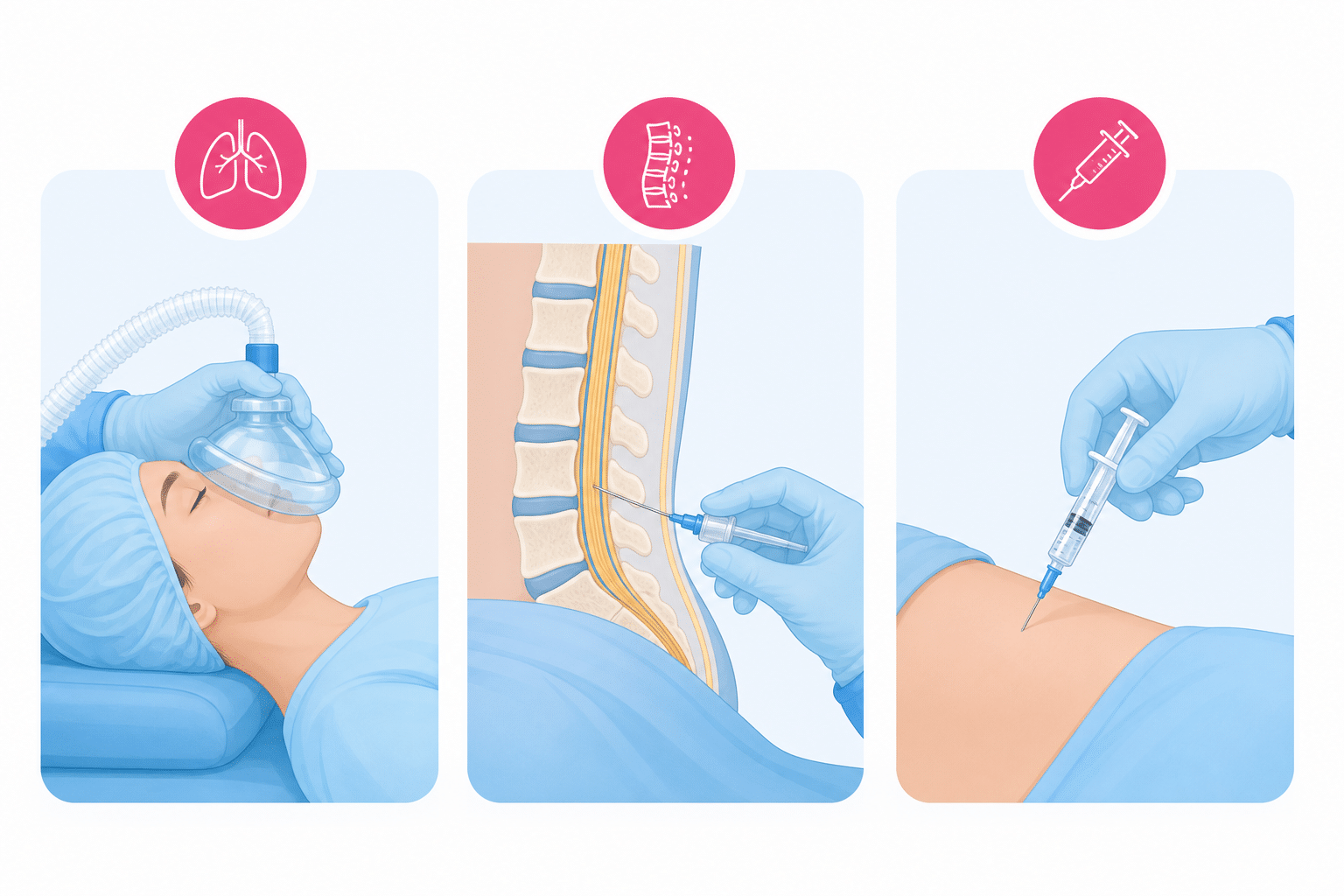
An overview of anaesthetic techniques: general anaesthesia, regional anaesthesia and local anaesthesia
Overview of the procedure
- General anaesthesia (full anaesthesia): complete loss of consciousness; airway management required
- Regional anaesthesia: numbs a specific area of the body; the patient remains awake or is lightly sedated
- Local anaesthesia: local anaesthesia for minor, outpatient procedures
According to the German Society for Anaesthesiology and Intensive Care Medicine (DGAI), the choice of anaesthetic technique depends on the planned procedure, the patient’s state of health and, where medically possible, the patient’s preferences. During the pre-anaesthesia consultation, the specific method to be used is explained:
| Procedure | Awareness | Typical application | Prevalence in cosmetic surgery |
|---|---|---|---|
| General anaesthesia (full anaesthesia) | Not available | Major procedures: breast augmentation, tummy tuck, liposuction | Very common |
| Regional anaesthesia (e.g. spinal anaesthesia) | Fully preserved | Surgery on the limbs, gynaecological surgery, lipoedema surgery | Frequently |
| Local anaesthesia | Fully preserved | Minor outpatient procedures: eyelid correction, wrinkle treatment | Frequently |
| Twilight sleep (analgosedation) | Drowsy state, reduced | Minor procedures where a general anaesthetic is not required | From time to time |
| Combined anaesthesia (balanced anaesthesia) | Not available | Complex or lengthy procedures; combined inhalation and intravenous anaesthesia | Very common |
General anaesthesia: What actually happens when you’re put under and when you wake up
General anaesthesia, commonly known as a general anaesthetic, is usually induced in adults using intravenous medication. Within a few seconds, the patient loses consciousness. During the operation, the anaesthetist continuously monitors the patient’s heart rate, blood pressure, oxygen saturation and depth of anaesthesia.
Patients wake up from general anaesthesia in the recovery room. There, the patient is monitored until their circulation and level of consciousness are stable. Nausea following anaesthesia, medically known as PONV (post-operative nausea and vomiting), is the most common side effect and occurs in around 20 to 30 % of patients. It can be effectively managed with preventive medication.
Regional anaesthesia: When general anaesthesia is not necessary
Many cosmetic procedures do not require general anaesthesia. Spinal anaesthesia, a form of regional anaesthesia in which a local anaesthetic is injected into the spinal canal, allows operations below the navel to be carried out whilst the patient remains fully conscious. Anyone who wishes to be fully aware of the procedure and remain more alert should discuss this option during the pre-operative consultation. Regional anaesthesia can often be combined with light sedation, so that the patient is relaxed but awake.

Risks and side effects of anaesthesia: assessing their frequency
Risk classification
- Common side effects (more than 1 in 10 patients): nausea, hoarseness, dizziness
- Rare complications (1 in 100 to 1 in 1,000): impaired wound healing, allergic reactions
- Very rare risks (fewer than 1 in 10,000): severe circulatory reactions, nerve damage
Risk disclosure is the core element of the anaesthesia consultation. In accordance with Section 630e of the German Civil Code (BGB), the doctor must inform the patient of all risks that are material to them, including rare ones, if these would have serious consequences should they occur. The following overview classifies typical anaesthetic risks according to their frequency:
| Risk / Side effect | Frequency | History |
|---|---|---|
| Nausea and vomiting (PONV) | Common (20–30 %) | Usually subsides within a few hours; responds well to treatment |
| Hoarseness, sore throat | Frequently following intubation | Resolves within a few days |
| Dizziness, light-headedness | Frequently | Temporary stay in the recovery room; it will go away on its own |
| Wound-healing complications following surgery | Rare | May require follow-up treatment; often exacerbated by underlying conditions |
| Allergic reaction to anaesthetics | Rare | Usually immediately recognisable and treatable; severe cases are very rare |
| Nerve damage (e.g. caused by positioning) | Very rare | Usually temporary; permanent damage is extremely rare |
| Aspiration (inhalation of stomach contents) | Very rare | Largely preventable by fasting before surgery |
The incidence figures in this table are based on general anaesthesiology data; individual risk profiles may vary. Patients with pre-existing conditions such as cardiovascular problems, diabetes or obesity are at increased risk of complications; this is precisely why the medical history is taken so carefully during the pre-operative consultation.
Important note
Disclosing any pre-existing conditions, medication and allergies during the pre-operative consultation is not merely a bureaucratic requirement, but directly safeguards your own safety. Incorrect or incomplete information can have dangerous consequences for the choice of anaesthetic.
Financial risks associated with anaesthetic complications: what health insurance covers – and what it does not
Insurance cover
- In the case of privately funded cosmetic surgery, the statutory health insurance scheme (GKV) only covers follow-up treatment under very specific conditions.
- The statutory health insurance scheme may reclaim emergency benefits already paid if the complication results from a procedure arranged privately.
- Follow-up care insurance covers this financial shortfall from the very first day of follow-up treatment.
Anaesthetic complications are rare, but their financial consequences can be significant. Anyone who pays for cosmetic surgery privately also bears the costs of any medically necessary follow-up treatment. Statutory health insurance is not obliged to cover the follow-up costs of cosmetic surgery, and may even reclaim the cost of emergency treatment if the original procedure was arranged privately.
In practical terms, this means that if a wound healing complication arises following a tummy tuck, requiring revision surgery, the patient must pay for this out of their own pocket. The same applies to hospital stays necessitated by a post-operative infection. Experience shows that such costs can quickly run to several thousand euros, regardless of whether the complication was caused by the anaesthetic procedure or the surgical procedure itself.
One Consequential Costs Insurance This cover addresses precisely this gap: medically necessary follow-up treatment, corrective surgery and hospital stays, with cover of up to 300,000 euros. Cover applies regardless of whether the cause lies with the anaesthesia procedure or the surgical procedure itself. You can take out the cover online up to 24 hours before the procedure.
Preparing for anaesthesia: What patients need to bear in mind before the procedure
Key measures
- Fasting: Do not eat anything for at least 6 hours before the anaesthetic, and do not drink anything (clear liquids) for 2 hours.
- Medication: Blood-thinning medicines (e.g. aspirin, ibuprofen) usually need to be stopped several days beforehand.
- Giving up nicotine: Smoking increases the risks associated with anaesthesia; it is recommended that you stop smoking at least 24 hours before your operation.
- Remove jewellery, nail varnish and contact lenses.
The specific preparations for anaesthesia will be discussed during the pre-operative consultation. Some points apply across the board and patients should be aware of them before the consultation takes place:
Sobriety: The most important safety rule before anaesthesia
Fasting before surgery is the most effective safeguard against the most dangerous complication of anaesthesia: aspiration, i.e. the accidental inhalation of stomach contents whilst under anaesthesia. According to the DGAI guidelines: solid food should be avoided for at least 6 hours before anaesthesia, whilst clear liquids (water, tea without milk) are permitted up to 2 hours beforehand. Some hospitals restrict clear liquids even earlier; the anaesthetist will specify the exact times during your consultation.
Discuss medicines and dietary supplements in good time
Blood-thinning medicines such as aspirin or ibuprofen increase the risk of bleeding during surgery. Depending on the active ingredient, you must stop taking them 3 to 10 days before the procedure. This also applies to certain dietary supplements such as fish oil or vitamin E. Anyone taking regular medication should bring an up-to-date list of their medicines to the pre-operative consultation; this saves time and helps to avoid any safety issues.
Frequently asked questions about pre-anaesthesia counselling
The pre-anaesthesia consultation must take place in good time to allow the patient to make their decision without feeling under time pressure. In accordance with Section 630e of the German Civil Code (BGB), for inpatient procedures the consultation must take place no later than the day before the operation. In the case of outpatient cosmetic procedures, the briefing may also take place on the day of the operation, provided there is sufficient time for any queries. If the patient is able to sign the consent form shortly before the procedure without any reservations, the briefing is formally valid, even if the timing appears unfavourable.
The pre-operative consultation is conducted exclusively by a specialist in anaesthesiology. The operating surgeon is not responsible for providing information about the anaesthesia; he or she conducts a separate consultation regarding the surgical procedure. Both consultations are independent and legally distinct.
Yes. The signature on the information sheet serves as proof of informed consent. Anaesthesia must not be administered without this consent. Patients are usually given a copy of the form. Consent may be withdrawn right up until the moment anaesthesia is administered; verbal withdrawal is sufficient.
Key points: You must fast (no solid food) for at least 6 hours; clear liquids are permitted up to 2 hours before anaesthesia. Blood-thinning medication and certain dietary supplements must be stopped several days beforehand. Jewellery, nail varnish and contact lenses must be removed before the operation. The exact procedure will be discussed on an individual basis during the pre-anaesthesia consultation.
In the case of general anaesthesia, no; patients are initially monitored in the recovery room after the procedure until their circulation and level of consciousness are stable. For outpatient procedures under local anaesthesia, a shorter monitoring period is possible. In any case, patients should not drive themselves; having someone accompany them home is recommended for both medical and legal reasons.
Cosmetic procedures do not involve any different anaesthetic risks to other operations. It is important to note, however, that they are often carried out on healthy patients without any medical necessity; the risk-benefit balance must therefore be assessed differently from that of medically indicated operations. Furthermore, statutory health insurance does not cover follow-up treatment resulting from complications, which has a significant impact on the financial planning for such a procedure.