Areola (areola)
The areola is the pigmented area of skin surrounding the nipple; its size, shape and position influence the outcome of breast surgery.
The nipple is usually located at the centre of the mammary gland, surrounded by a pigmented area of skin known in medical terminology as the areola. In plastic and aesthetic breast surgery, the areola plays a crucial role, as its size, shape and position have a significant influence on the overall aesthetic outcome of an operation.
This article explains clearly and in detail what the areola is and why its adjustment is an integral part of many breast operations.
Table of Contents
Important note
This article is for information purposes only and is not a substitute for a medical diagnosis or advice. If you are unsure, or if you require a personalised treatment plan, it is essential that you consult a qualified specialist.
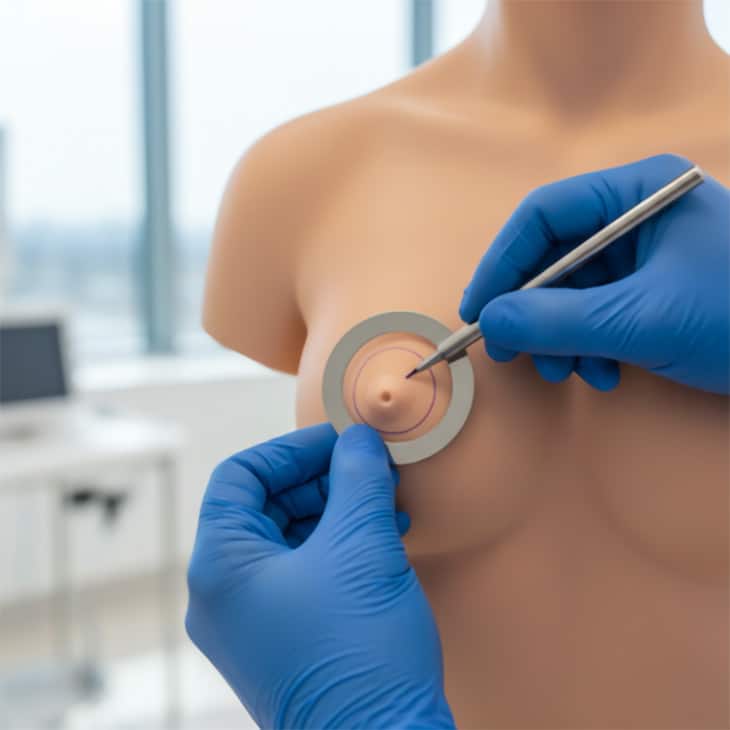
What is the areola?
The areola (Latin for „small courtyard“), known in German as the ‘Brustwarzenhof’, is the circular area of skin – usually darker in colour – that surrounds the nipple (mamilla). Its size and colour vary greatly from person to person. The areola contains small sebaceous glands (the Montgomery glands), which help to keep the skin supple.
The role of the areola in breast surgery
A well-shaped breast is characterised by harmonious proportions. This also means that the size and position of the areola must be in keeping with the new breast size and shape. For this reason, areola correction is often a crucial step in breast reshaping surgery.
Areola correction during a breast lift (mastopexy)
In the case of sagging breasts, not only has the glandular tissue dropped, but the skin covering it has also become overstretched. This can often lead to an enlargement and stretching of the areola as well.
Surgical procedure: During a breast lift, the areola is reduced in size by removing an outer ring of pigmented skin. The remaining areola is then sutured to the surrounding skin. At the same time, the entire nipple-areola complex is repositioned higher up, giving it a more youthful appearance.
Areola correction during breast reduction surgery (reduction plasty)
As with a breast lift, the areola is often disproportionately large following a breast reduction.
Surgical procedure: Areola reduction is a standard part of breast reduction surgery. The surgeon adjusts the diameter of the areola to match the new, smaller breast size and repositions it.
Areola incision in breast augmentation (mammoplasty)
In breast augmentation surgery, the areola can serve as an access point for inserting the implant.
Periareolar incision: The incision is made precisely at the junction between the pigmented areola and the normal skin of the breast. Once healed, the scar is often barely noticeable due to the difference in skin colour. This approach is often chosen when a slight tightening or reduction of the areola is also desired.
Risks and the importance of insurance cover
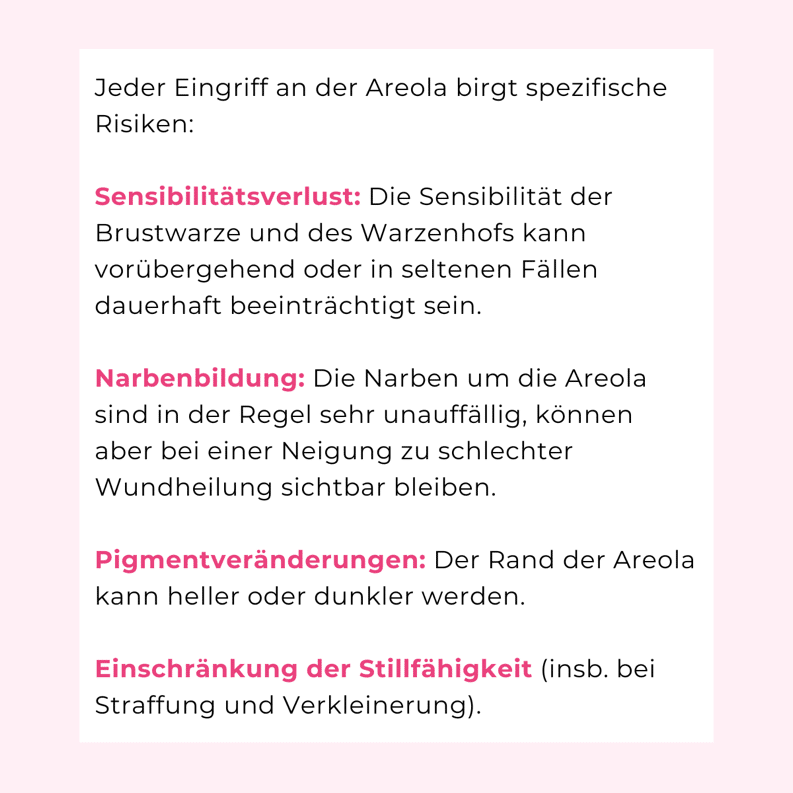
These risks form part of the overall risk associated with breast surgery.
Eine Folgekostenversicherung ist dafür konzipiert, die finanziellen Folgen von Komplikationen nach einem ästhetischen Eingriff abzusichern – informieren Sie sich bei 4beauty über die optimale Absicherung Ihrer Operation.
Frequently Asked Questions about Areola Correction
Yes, it is possible to reduce the size of the areola as a standalone procedure. It is a minor procedure that can usually be carried out under local anaesthetic.
There is no universally „perfect“ size. Aesthetically, a diameter of 3.8 to 4.5 cm is often considered harmonious. However, an experienced surgeon will always plan the size in proportion to the patient’s individual breast size and shape.
In the vast majority of cases, the periareolar scar heals very well. The natural difference in colour between the areola and the surrounding skin acts as a kind of „camouflage“, making the fine scar line very inconspicuous.