Biofiller
The biofiller, also known as a plasma filler, is a gel made from the patient’s own blood which treats wrinkles and restores volume without the use of synthetic additives.
Table of Contents
Important note
This article is for information purposes only and is not a substitute for a medical diagnosis or advice. If you are unsure, or if you require a personalised treatment plan, it is essential that you consult a qualified specialist.
The desire for a natural look and treatments that are in harmony with one’s own body is a growing trend in aesthetic medicine. In this context, so-called ‘biofillers’, also known as plasma fillers, are becoming increasingly popular. They promise to treat wrinkles and restore volume. The gel is derived entirely from the patient’s own blood and contains no synthetic additives.
But how exactly does this method work, what can it achieve and – most importantly – how safe is it really? In our glossary entry, we take an objective look at the biofiller, explain the process and provide you with a realistic assessment of the benefits and risks.
Definition: What is a biofiller?
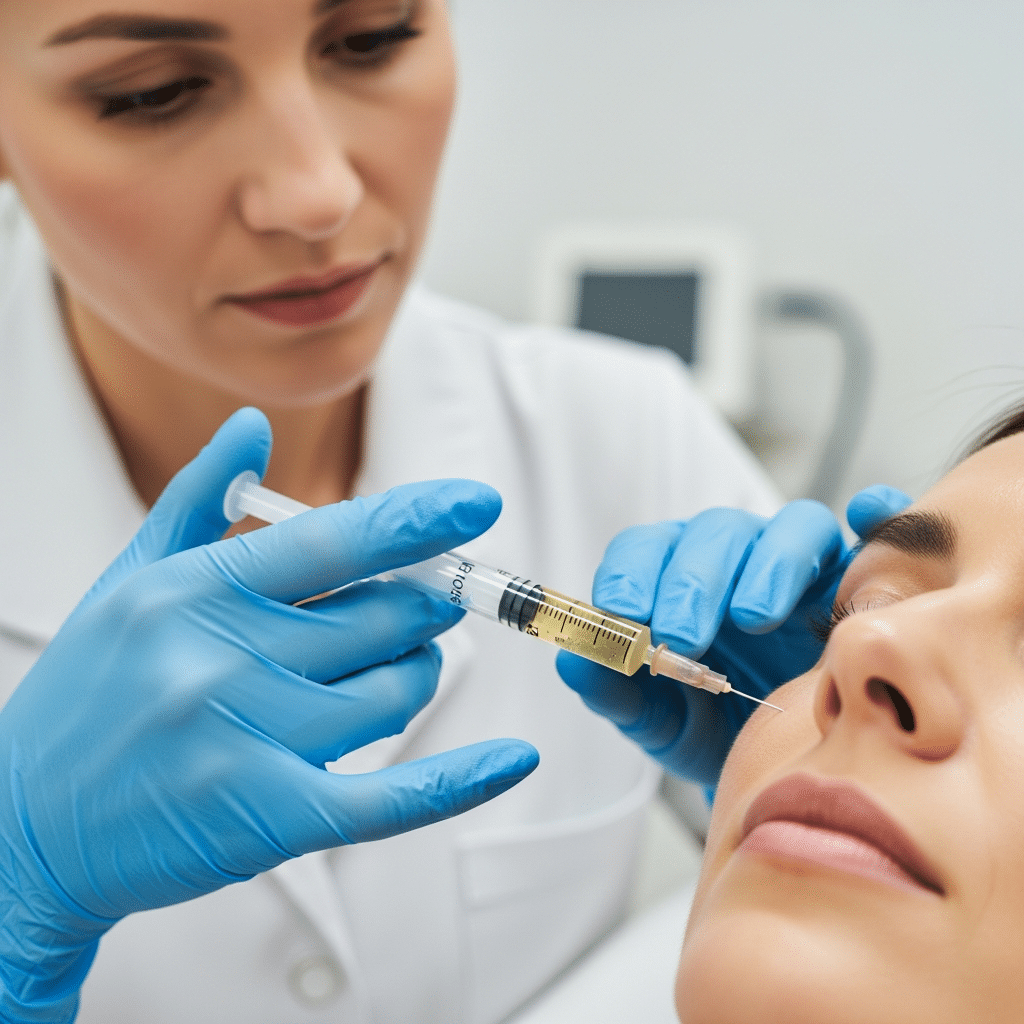
A Biofiller, also Plasma filler or PRF filler known as, is a gel-like filler derived entirely from the patient’s own blood. A special process is used to produce a gel from the blood plasma, which is rich in blood platelets (thrombocytes) and growth factors.
This autologous gel is then used in the same way as a conventional dermal filler to Injection used to treat wrinkles, add volume or improve skin quality.
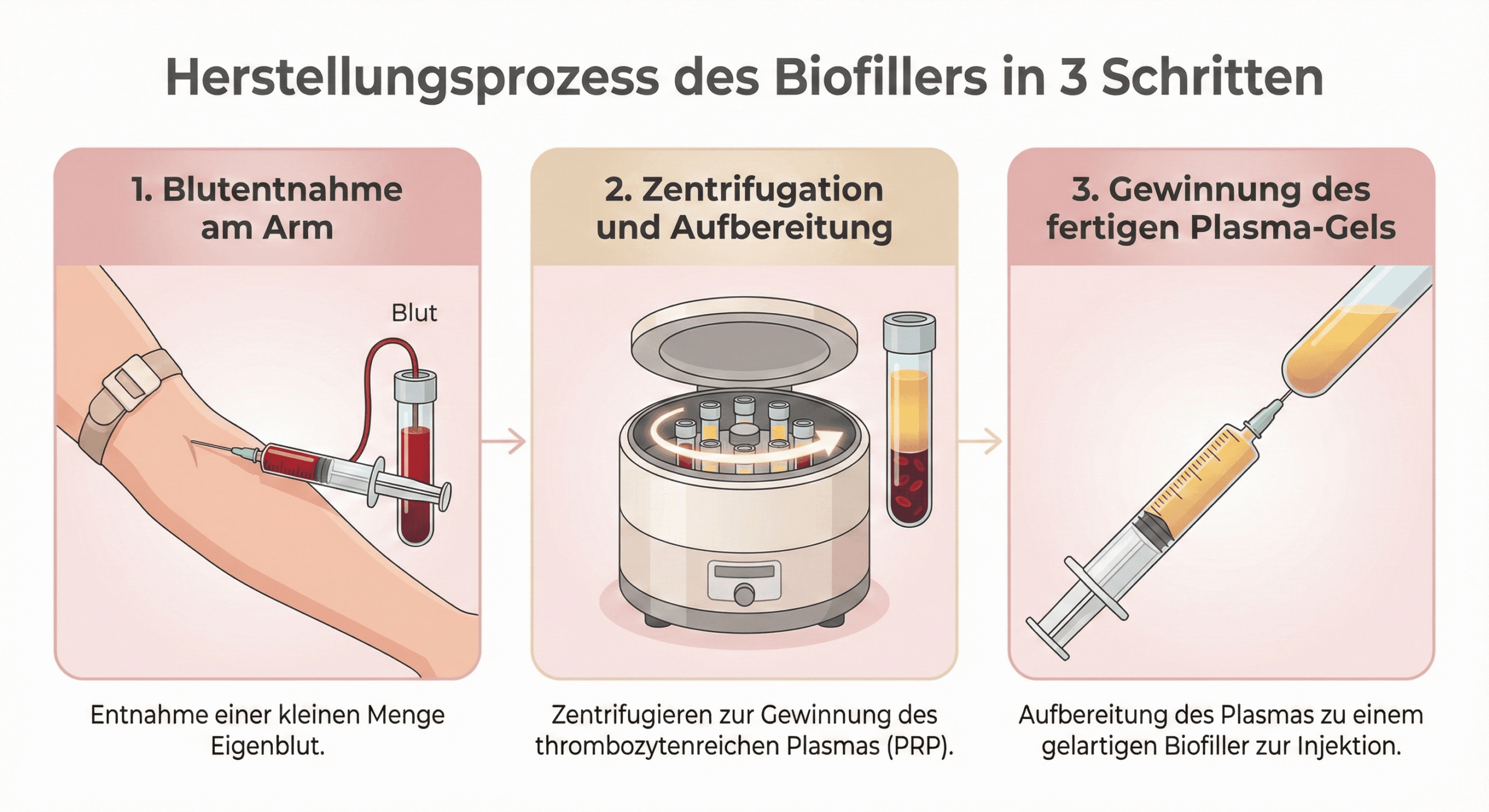
How is the biofiller produced? The process in 3 steps
The biofiller is prepared directly at the practice immediately before the treatment and usually takes around 30 to 45 minutes.
- Step 1: Blood sample collection A small amount of blood is taken from the patient’s arm vein, much like a normal blood test at the GP’s surgery.
- Step 2: Centrifugation and processing The blood is placed in special tubes and put into a centrifuge. The rapid rotation causes the blood components to separate: the red blood cells settle at the bottom, whilst the pale yellow blood plasma remains at the top. For the biofiller, platelet-rich fibrin (PRF) is obtained through a specialised centrifugation process, which creates a fibrin coagulation network containing platelets and growth factors.
- Step 3: Preparing the gel and administering the injection The PRF coagulation network obtained is transformed, through a controlled process, into a gel-like, injectable consistency which can be liquefied by the body’s own heat or, if necessary, by gentle heating. The treating doctor or alternative practitioner can then inject this finished plasma gel into the desired areas using fine needles.
How does the biofiller work in the skin?
1. Instant volume effect: The injected gel immediately fills in wrinkles and areas of volume loss, much like a hyaluronic acid filler. The immediate volumising effect is temporary, as the body breaks down the gel after a few months. However, the biostimulating effect on collagen production lasts longer.
2. Biostimulation: This is the key, long-term effect. The growth factors, which are highly concentrated in the PRF, stimulate the body’s own regenerative processes and can encourage fibroblasts (connective tissue cells) to produce new collagen and elastin. However, the effectiveness varies from person to person.
Biofillers vs. hyaluronic acid: a critical comparison
| Characteristic | Biofiller (Plasma Filler) | Hyaluronic acid fillers |
|---|---|---|
| Material | 100 % autologous | Synthesised, but identical to natural substances |
| Compatibility | Excellent, no allergic reactions | Very good; allergies are extremely rare |
| Mode of action | Volume + Biostimulation (collagen production) | Primarily volume & moisture retention |
| Lifting capacity | Low, ideal for smooth transitions | High, ideal for contouring (chin, cheeks) |
| Result | Very natural, but harder to predict | Highly precise and predictable |
| Shelf life | 3–6 months; regenerative effects last longer | 6–18 months, depending on the product and region |
| Resolvability | Cannot be specifically resolved | Can be specifically broken down by the enzyme hylase |
Areas of application and limitations of the treatment
- Filling in mild to moderate wrinkles (e.g. Nasolabial folds)
- Treatment of dark circles and tear troughs
- Improvement in skin quality and firmness
- Natural, gentle volume enhancement in the cheeks
Key limitations: For deep wrinkles or pronounced contouring (e.g. jawline, chin augmentation), hyaluronic acid fillers are often the better choice due to their greater stability and lifting capacity.
Risks & Side Effects: When „natural“ does not mean risk-free
Important safety information and risks
- Common side effects: As with any injection, swelling, redness, mild pain and small bruises (Haematomas) are normal and subside after a few days.
- Process-related risks: The safety of the procedure depends entirely on maintaining sterile working practices, the quality of the equipment and the operator’s experience. If hygiene standards are not met, there is a serious risk of infection, as the procedure involves the use of blood products.
- Application risks: Improper injection by an inexperienced user can lead to asymmetry, nodule formation or uneven results.
- Lack of long-term data: Compared with hyaluronic acid, which has been the subject of research for decades, the biofiller is a more recent method. Comprehensive long-term studies on its safety and efficacy have not yet been completed, but initial clinical findings show promising results.
It is therefore crucial to choose a qualified doctor or alternative practitioner with proven experience in autohaemotherapy.
The conclusion of a Consequential Costs Insurance can provide patients with additional peace of mind: it comes into effect if unexpected medical complications arise and the treatment incurs additional costs that are not covered by standard health insurance.
How much does a Biofiller treatment cost?
Cost of a Biofiller treatment
The cost of a biofiller treatment is higher than that of a standard PRP therapy, as the preparation process is more complex. Costs vary depending on the clinic, the region and the quantity required.
On average, you can expect costs of between €400 and €800 per session calculate.
Frequently Asked Questions (FAQ) about Biofiller
Having your blood taken involves a quick prick. The injections themselves can feel uncomfortable, so an anaesthetic cream is usually applied to the skin beforehand.
In a vampire facelift, liquid, platelet-rich plasma (PRP) is injected superficially into the skin or introduced via microneedling to improve skin quality. With the Biofiller treatment, the plasma (PRF) is processed into a thick gel which can also add volume.
To achieve a visible and longer-lasting effect, 2–3 treatments at intervals of approximately 4–6 weeks are often recommended. After that, annual touch-ups are sufficient.
The gel’s immediate volumising effect lasts for around 3 to 6 months. However, the stimulating effect on collagen production and the associated improvement in skin condition lasts considerably longer.
Yes. Contraindications include, amongst others, blood clotting disorders, acute or chronic infectious diseases, cancers and autoimmune diseases. Pregnancy and breastfeeding require an individual assessment of the risks and should always be discussed with the treating doctor.