Bio-Lift
Bio-Lift is marketed as a gentle, natural skin-tightening treatment, but does not refer to any standardised, medically defined procedure.
The term „Bio-Lifting“ sounds tempting: it suggests a gentle, natural and biological form of skin tightening, without any invasive procedures. More and more salons and clinics are promoting this procedure as a gentle alternative to Botox, fillers or even a facelift. But if you take a closer look, you’ll realise that there is no standard, medically defined treatment called a „Bio-Lift“. So what is really behind this trend?
In this informative glossary entry, we break down the marketing term, explain the underlying principle of biostimulation and show you which reputable medical procedures most commonly underpin the promise of a „Bio-Lift“.
Table of Contents
Important note
This article is for information purposes only and is not a substitute for a medical diagnosis or advice. If you are unsure, or if you require a personalised treatment plan, it is essential that you consult a qualified specialist.
Definition: „Bio-Lift“ – A marketing term, not a procedure
The term „Bio-Lifting“ or „Biological facelift“ is not a regulated or standardised medical treatment. Rather, it is a collective term from the world of marketing, used by various providers to describe a wide range of minimally invasive or non-invasive skin rejuvenation procedures.
The common thread is usually the claim that these treatments stimulate the skin to regenerate in a „natural“ or „body-friendly“ way, rather than artificially filling it or tightening it surgically.
The common principle: biostimulation to promote collagen production
Although the methods vary, almost all treatments referred to as „Bio-Lift“ are based on the same principle: biostimulation.
This involves applying targeted stimuli to the skin to activate the fibroblasts (the „factories“ of the connective tissue). These stimulated cells then produce increased amounts of the body’s own collagen and elastin. The result is not an immediate, dramatic improvement, but a gradual, natural firming and enhancement of the skin’s structure from within over a period of several weeks and months.
What’s behind it? A look at the most common methods
If you are offered a „Bio-Lift“, it is usually one of the following reputable medical treatments, or a combination of them:
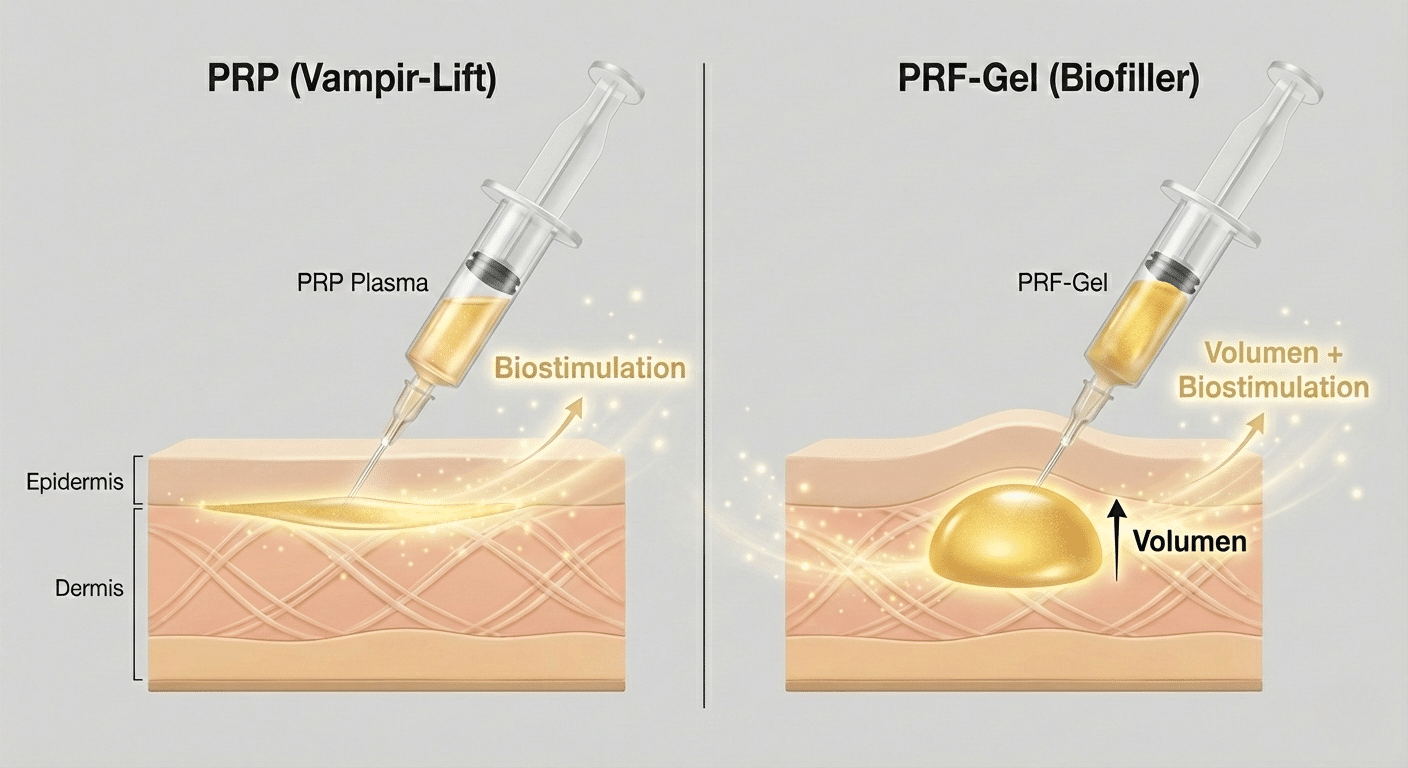
Method 1: Autologous blood therapy (PRP / „vampire facelift“)
Autologous blood therapy is one of the most common treatments marketed under the name „Bio-Lift“.
What it is: Your own blood is processed by centrifugation platelet-rich plasma (PRP) extracted. This concentrate of growth factors is then injected into the skin’s surface or applied using microneedling.
How it works: The growth factors in PRP provide a powerful stimulus for fibroblasts to produce new collagen. The skin becomes firmer, thicker and more radiant.
Ideal for: Improvement in overall skin quality, fine lines, dull complexion.
Method 2: The biofiller made from the patient’s own blood (PRF gel)
This is a further development of PRP therapy and is also often referred to as a „Bio-Lift“ by some providers.
What it is: Here, platelet-rich fibrin (PRF) derived from the patient’s own blood is processed into a gel using a specialised process. This Biofiller can be injected like a traditional filler to add volume.
How it works: It offers a dual effect: an immediate, subtle volumising effect thanks to the gel, and the same long-term biostimulation effect as PRP.
Ideal for: Slight loss of volume (e.g. under the eyes), filling in of fine lines.
Do ask!
As „Bio-Lift“ is not a protected term, it is essential that you always ask your practitioner exactly which medical procedure they are using under this name. Ask for a detailed explanation of the procedure (e.g. „PRP therapy with microneedling“) and the materials used.
Realistic expectations: What a „Bio-Lift“ cannot do
The methods grouped under the term „Bio-Lift“ are effective in improving skin quality and providing a slight lifting effect. However, they are not an alternative to a surgical facelift.
- No significant lifting effect: A „Bio-Lift“ cannot lift sagging tissue to the same extent as a thread lift or a surgical facelift.
- No substitute for volume: In cases of significant loss of facial volume, hyaluronic acid fillers or autologous fat transfer are often the more effective solution.
- Results take time: As collagen production is a slow process, the final result develops over 2–3 months.
Risks: Why „organic“ does not mean „risk-free“
The term „organic“ suggests absolute safety. This is misleading. Even though allergic reactions are highly unlikely when using the body’s own tissue, there are still risks:
Risk of infection
Any treatment involving a blood sample or a breach of the skin barrier carries a serious risk of infection if carried out under unhygienic conditions.
Application error
An improper injection carried out by an inexperienced practitioner may result in lumps, asymmetry or unsatisfactory results.
Qualifications are crucial
Choose only qualified doctors who have a proven track record of experience with the specific procedure (e.g. PRP) and who work in a sterile environment.
Should any complications arise, costs may be incurred for corrective treatment. A Consequential Costs Insurance This provides sensible financial protection, as health insurance schemes do not usually cover these costs.
Frequently Asked Questions (FAQ) about Bio-Lifting
It is suitable for people who wish to achieve a natural improvement in their skin’s appearance, a reduction in fine lines and a slight preventive tightening, but who do not yet require or wish to undergo surgery.
As most „Bio-Lifts“ are based on the PRP method, the results last for around 12 months following an initial course of approximately three sessions. Regular touch-ups are necessary to maintain the results.
The blood test involves a quick prick. The treatment itself (e.g. microneedling or injections) is usually carried out after an anaesthetic cream has been applied and is quite tolerable.
The cost depends entirely on the specific method used. A single PRP session („vampire facelift“) usually costs between €300 and €600.
A thread lift achieves a stronger, mechanical lifting effect by inserting tension threads. A PRP-based Bio-Lift works primarily by biologically stimulating and improving the skin’s structure, without mechanically lifting the tissue.