Breast Feather Lift
The Breast Feather Lift is not a procedure in its own right, but rather a marketing term for a minimally invasive breast lift using absorbable sutures.
Table of Contents
Important note
This article is for information purposes only and is not a substitute for a medical diagnosis or advice. If you are unsure, or if you require a personalised treatment plan, it is essential that you consult a qualified specialist.
The term „Breast Feather Lift“ sounds like a dream come true: a breast lift as light and gentle as a feather, with no surgery, no scars and no long recovery time. Yet behind this enticing marketing name lies a minimally invasive procedure with very clear and strict limitations. Having realistic expectations is not only important here, but crucial to avoiding disappointment and unnecessary expense.
In this glossary entry, we explain what a breast feather lift actually is, how it works and – most importantly – for which small group of people it is actually suitable, and when a surgical breast lift is the only sensible alternative.
Important note:
The content provided on this page is for general information and educational purposes only. A breast thread lift is an invasive procedure with significant limitations and risks. An honest consultation with an experienced specialist is essential to determine whether you are a suitable candidate.
Definition: What is a breast feather lift?
What is a breast feather lift?
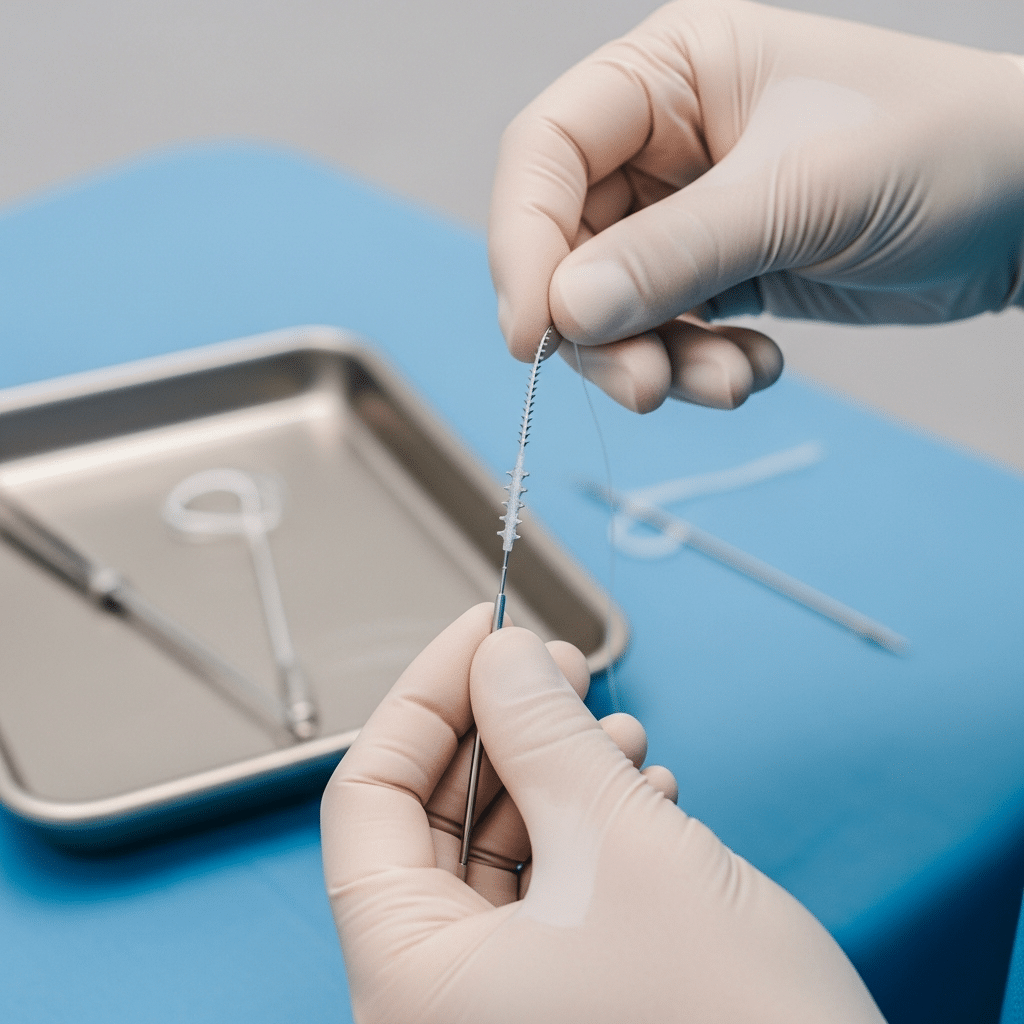
The A breast feather lift is not a medical procedure in its own right, but a Marketing term for a minimally invasive breast lift using a thread lift.
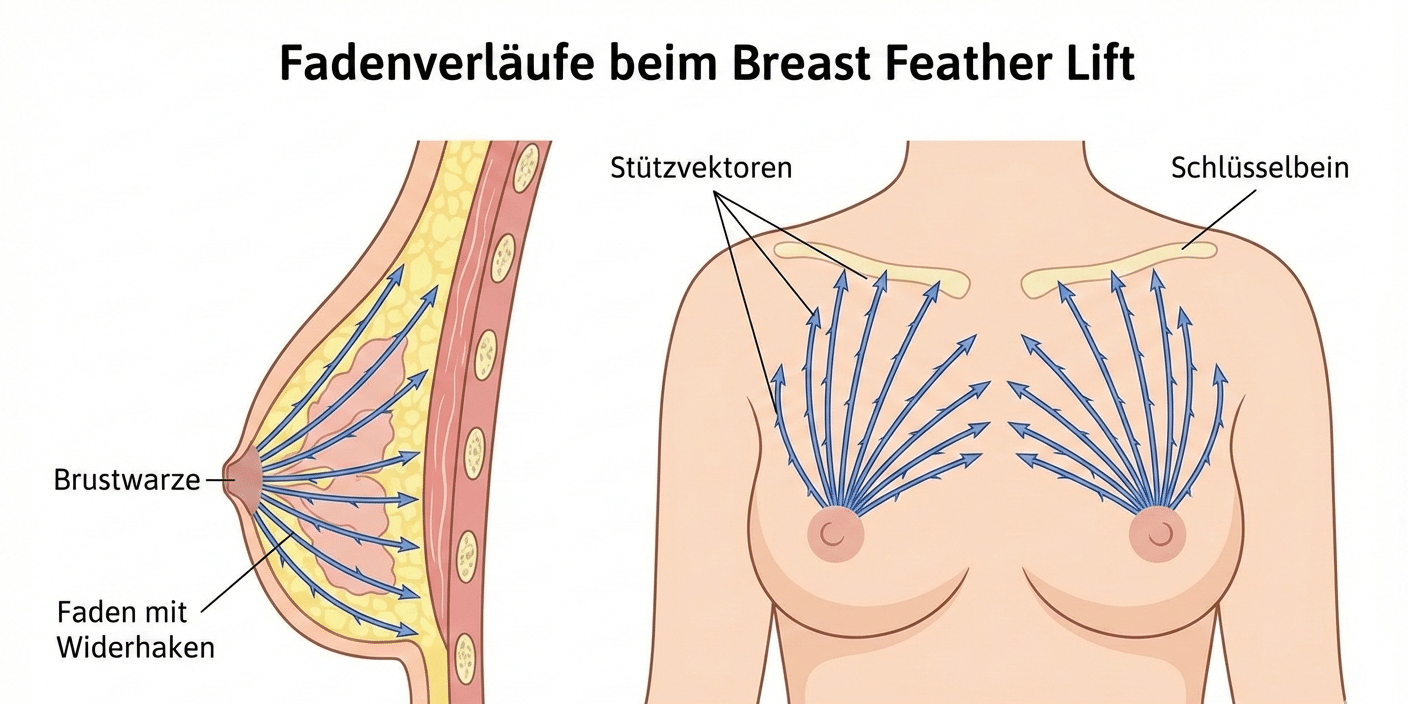
In this procedure, self-dissolving (resorbable) sutures with small barbs (known as „cogs“) are inserted into the subcutaneous fatty tissue of the breast to gently lift and support the tissue. The name ‘Feather Lift’ is intended to emphasise the gentleness and minimally invasive nature of the procedure.
How does a thread lift for the breasts work?
As with any thread lift, the result is down to a dual effect:
Lightweight mechanical lift: The barbs on the sutures anchor themselves in the tissue. By applying gentle tension, the doctor can lift the breast tissue slightly and reposition it.
Long-term biostimulation: The thread material (usually PDO or PLLA) stimulates the body to produce new collagen. This collagen network, produced by the body itself, provides gentle, natural firming from within, which lasts for some time even after the threads have dissolved.
The crucial question: Am I even a candidate?
This is the most important and honest part of the article. A breast feather lift is only a sensible option for a very small and specific group of women.
The strict criteria for a Feather Lift:
A thread lift of the breasts is primarily suitable for women with:
- Small to moderate breast size: Cup size A or B, or at most a small C cup.
- Minimal sagging: Mild to moderate ptosis (Grade 1–2), in which the nipple lies, at most, slightly above the inframammary fold.
- Good skin quality: Skin that is still firm and supple.
- Realistic expectations: The understanding that only a minimal lifting effect of a few millimetres up to a maximum of 1–2 centimetres is achieved.
Who is the Breast Feather Lift NOT suitable for?
For the overwhelming majority of women who wish to have a breast lift. This includes women with a cup size of B or larger, those with clearly visible sagging breasts (grade 2 or 3 ptosis), those who have lost a significant amount of weight or have given birth, and those with poor skin quality. The weight of the breast tissue is simply too great for the fine sutures – the result would not last long.
Feather Lift vs. Surgical Breast Lift: An Honest Comparison
For all women who do not fall within the narrow target group mentioned above, surgical Breast lift (Mastopexy) is usually the only effective method.
| Characteristic | Breast Feather Lift (thread lift) | Surgical breast lift (mastopexy) |
|---|---|---|
| Principle | Breast lift using internal sutures | Removal of excess skin and reshaping of the breast |
| Effectiveness | Minimal lift (max. approx. 1–2 cm) | A noticeable, contouring lift (up to several centimetres) |
| Scars | Just tiny puncture marks | Visible but predictable scars (e.g. around the nipple, vertical or T-shaped) |
| Anaesthesia | Local anaesthesia | General anaesthesia |
| Shelf life | Temporary (approx. 12–24 months) | Long-lasting (often for many years) |
| Ideal for | Very small breasts with minimal sagging | Any type of sagging breast |
Risks and complications associated with the procedure
Although it is minimally invasive, the procedure is not without risk. The breast is an anatomically sensitive area.
- Common side effects: Swelling, bruising, mild pain.
- Specific risks: Asymmetry, visible or palpable sutures (particularly where the skin is thin), skin indentations, infections, suture rupture or migration, damage to milk ducts or nerves, and, above all, a an unsatisfactory result, or one that is only very short-lived.
Should a complication arise that requires treatment, in the vast majority of cases you will have to bear the costs of corrective treatment yourself. A policy taken out before the procedure Consequential Costs Insurance can provide important financial security here.
Procedure, results and costs of the Breast Feather Lift
Procedure: The procedure takes around 60 minutes and is carried out on an outpatient basis under local anaesthetic. Afterwards, a supportive sports bra must be worn for a few weeks.
Shelf life: The visible lifting effect often diminishes significantly within 6–12 months; the firming effect achieved through collagen stimulation can last for up to around 1–2 years, depending on the thread material and technique used.
Costs: The cost of a thread lift for the breasts varies considerably, but is usually between €1,500 and €3,000.
Frequently Asked Questions (FAQ) about the Breast Feather Lift
No, absolutely not. It is purely a tightening procedure without the addition of any volume.
Thanks to the local anaesthetic, the insertion of the threads is relatively painless. However, a pulling sensation and a feeling of pressure are normal.
If positioned correctly within the subcutaneous fatty tissue, the milk ducts should not be damaged. However, the sutures may be visible on an ultrasound scan or mammogram, which is why the radiologist must be informed about the procedure.
Please allow for a recovery period of around 3–7 days. You should avoid exercise and sleeping on your stomach for at least 2–3 weeks.
That depends entirely on your body shape and your expectations. For the very small group of women who only need a minimal amount of tightening, it may be an option. For most women, however, the results are often disappointing in relation to the cost.