Ear reduction: Surgical correction of oversized ears (macrotia)
Ear reduction is a plastic surgery procedure carried out to correct ears that are too large (macrotia) and appear out of proportion to the rest of the face.
Whilst protruding ears are a well-known issue, some people suffer from a different problem: their ears do not necessarily protrude, but are too large overall (macrotia) and therefore appear out of proportion to the rest of the face. There is a specific plastic surgery procedure for this condition: ear reduction.
This article provides a clear and comprehensive explanation of what an ear reduction is, how it differs fundamentally from an ear pinning procedure, and what you need to know about the procedure and the inevitable scarring.
Table of Contents
Important note
This article is for information purposes only and is not a substitute for a medical diagnosis or advice. If you are unsure, or if you require a personalised treatment plan, it is essential that you consult a qualified specialist.
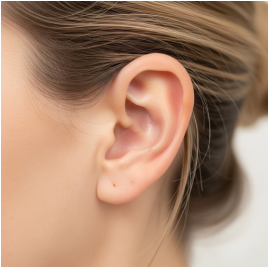
What is ear reduction surgery?
Ear reduction, also known as auricular reduction, is a surgical procedure designed to reduce the overall size of the outer ear.
Unlike the procedure to correct protruding ears, in which the cartilage is simply reshaped, ear reduction surgery actually involves the permanent removal of parts of the ear cartilage and the overlying skin in order to reduce the overall height and/or width of the ear.
Ear reduction vs. ear pinning (otoplasty): The key difference
| Criterion | Otoplasty (ear pinning) | Ear reduction |
|---|---|---|
| Purpose of the procedure | Correction of protruding ears by reshaping the cartilage | Ear reduction through the removal of skin and cartilage |
| Cartilage treatment | The cartilage remains intact; it is simply reshaped (e.g. the anthelix fold) | Surgical removal of cartilage to reduce its size |
| Change in ear size | None – the size remains the same | Yes – the ear is made smaller overall |
| Typical combination | As a stand-alone procedure or combined with a reduction if necessary | Often used in combination with an ear mould (e.g. for large, protruding ears) |
Who is an ear reduction procedure ideal for?
Ear reduction surgery is the right solution for patients who feel their ears are too large, too long or out of proportion with their head and face. This may affect the entire outer ear or just parts of it, such as disproportionately large earlobes. The procedure is usually carried out on young people aged 16 and over, or on adults, once the ears have finished growing.
The operation: procedure and incision technique
- Marking The surgeon precisely marks the areas of skin and cartilage to be removed in order to achieve a symmetrical and natural result.
- Incision and removal A common technique involves removing a wedge-shaped piece from the upper part of the outer ear, with the incision positioned as far as possible within a natural fold of the outer edge of the ear (helix), so that the resulting scar is as inconspicuous as possible.
- Reconstruction After the tissue has been removed, the remaining cartilage and skin margins are sutured back together precisely and without tension. The surgeon’s skill lies in perfectly reconstructing the ear’s natural, curved shape.
- Earlobe reduction If the earlobe is also too large, excess tissue can be removed from the lower edge and the earlobe reshaped. The scar is discreetly located along the lower edge.
Potential risks and the right cover for your operation
Ear reduction is considered a routine procedure in the field of plastic surgery; however, like any operation, it carries specific risks:
- Wound-healing disorders or infections, in particular perichondritis
- Unsatisfactory aesthetic result (e.g. visible cartilage edges, asymmetry)
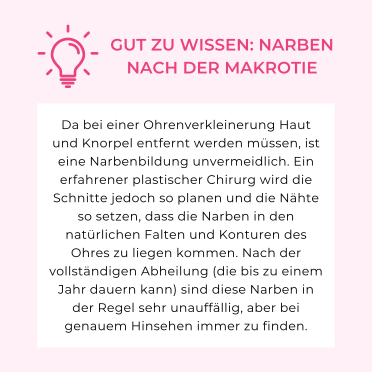
- Prominent scarring (hypertrophic scars or keloids)
- Temporary or, in rare cases, permanent sensory disturbances in the ear
Treating such complications can be costly. As this is a purely cosmetic procedure, the costs are not covered by health insurance. A Consequential Costs Insurance provides financial security in the event that medically necessary follow-up treatment is required after your operation.
Frequently Asked Questions (FAQ) on ear reduction surgery
As the procedure is more complex than a simple ear-pinning operation, the costs are generally higher and usually range between 3,500 and 5,500 euros.
As with ear pinning, a head bandage is worn for about a week, followed by a headband at night for several weeks. The most severe swelling usually subsides within the first 1–2 weeks; however, slight residual swelling may persist for several weeks.
Yes, as the cartilage and skin are permanently removed, the results of the reduction are permanent.
Yes. If the ears are both too large and protruding, the surgeon will carry out both corrections in a single operation to achieve a harmonious overall result.