Hirsutism
Hirsutism refers to the growth of dark, coarse hair on women in areas typically associated with men – it is not a disease in itself, but a symptom of a hormonal imbalance.
Table of Contents
Important note
This article is for information purposes only and is not a substitute for a medical diagnosis or advice. If you are unsure, or if you require a personalised treatment plan, it is essential that you consult a qualified specialist.
Unwanted hair growth is a major source of distress for many women. This is particularly true when dark, coarse hair grows in areas typically associated with men – such as on the face, chest or back. In such cases, the medical term used is hirsutism. It is important to understand that hirsutism is not a disease in its own right, but a visible symptom of an underlying hormonal imbalance.
This guide explains, in a clear and empathetic way, what hirsutism is and how it differs from non-hormonal Hypertrichosis distinguishes between these, and introduces you to the effective two-pronged strategy for tackling the problem both at its root and on the surface.

Definition: What is hirsutism?
Hirsutism is the medical term for excessive hair growth in women, which follows a male pattern of distribution. It is characterised by the growth of thick, dark and bristly hair (terminal hair) on androgen-dependent parts of the body.
This is caused either by an overproduction of male hormones (androgens) or by the hair follicles being more sensitive to these hormones.
Hirsutism vs. hypertrichosis: the key difference
It is essential not to confuse these two conditions, as their causes and treatments are fundamentally different.
| Characteristic | Hirsutism | Hypertrichosis |
|---|---|---|
| Cause | Hormonal (excess male hormones) | Not androgen-related (e.g. genetic or drug-induced) |
| Those affected | Almost exclusively women | Men, women and children |
| Hair type | Thick, dark terminal hair is essential | Mostly fine vellus hair, with some terminal hair as well |
| Distribution patterns | Depending on the male pattern of hair growth (e.g. beard, chest, back) | Regardless of the male pattern of hair growth (e.g. over the whole body) |
The cause: Why male hormones (androgens) play the key role
The female body also produces small amounts of male hormones such as testosterone. In hirsutism, this balance is disrupted.
PCOS (Polycystic Ovary Syndrome)
This is by far the most common cause of hirsutism. In this metabolic disorder, the ovaries produce too many androgens.
Other causes
Less commonly, tumours of the ovaries or adrenal glands, certain medicines or other hormonal disorders or hormonal imbalances may be to blame.
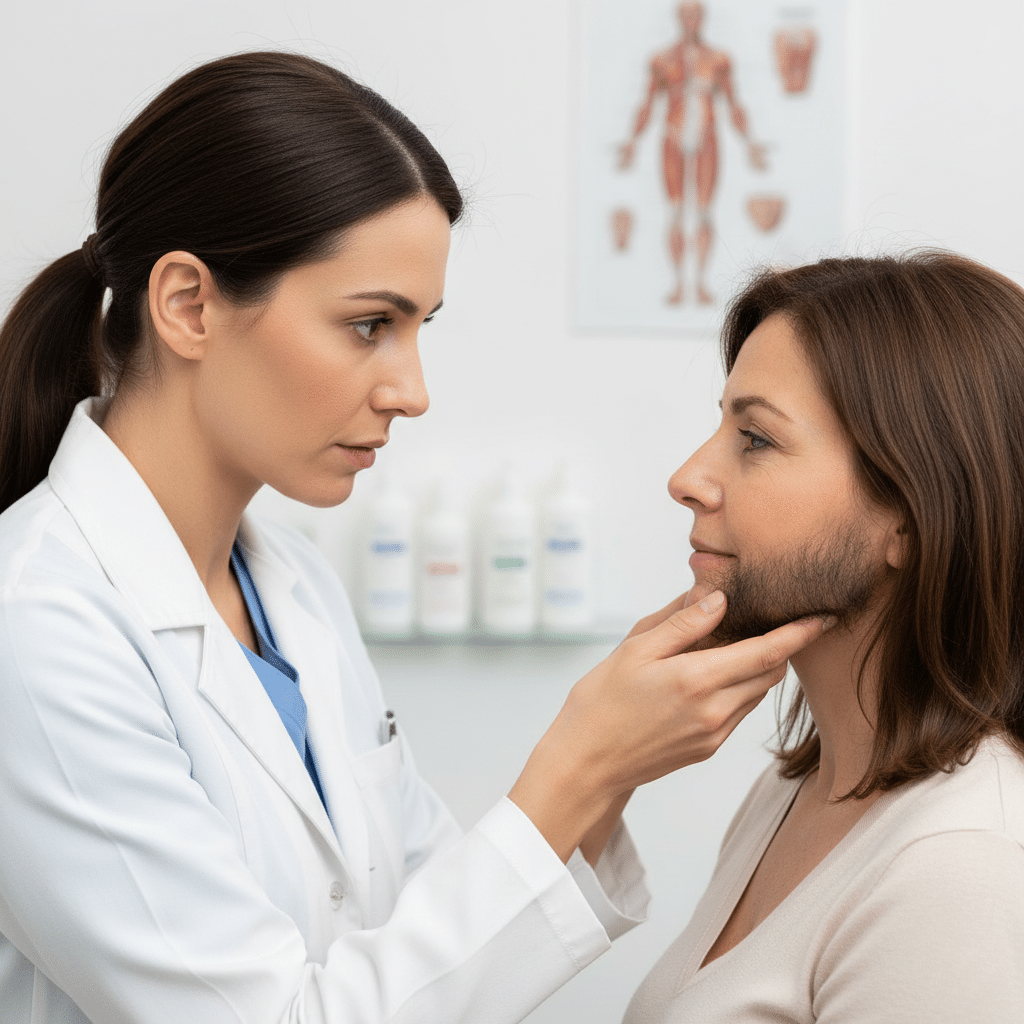
The path to a diagnosis: gynaecologist & endocrinologist
Do not self-diagnose: always see a specialist!
As hirsutism can be a symptom of a serious medical condition, a thorough medical assessment is essential. The first point of contact is the Gynaecologist (women’s doctor) or a Endocrinologist (hormone specialist). The doctor will carry out a physical examination, a hormone test (blood test) and, in many cases, an ultrasound scan of the ovaries to determine the cause.
To assess the severity, the Ferriman-Gallwey Score which is used to assess body hair in nine defined areas of the body.
The ‘two-pillar’ approach: an effective strategy
Successful treatment of hirsutism always consists of two complementary approaches, which are ideally used in combination.
Pillar 1: Medical treatment of the hormonal cause
This part is designed to correct the hormonal imbalance. It must be prescribed and monitored by a doctor.
- Hormonal contraceptives: Certain contraceptive pills have an anti-androgenic effect and can reduce the production of male hormones.
- Antiandrogens: Medicines that block the effects of male hormones directly within the body. These treatments take effect gradually over a period of months, but they stop new hair from growing and can make existing hair thinner.
Pillar 2: The aesthetic treatment of visible hair
Whilst medical treatment tackles the root cause, these procedures ensure the rapid and effective removal of existing, unwanted hair.
- Laser hair removal: This is the method of choice for many people affected by this condition. The laser light is absorbed by the pigment in the hair and converted into heat, which destroys the hair root. It is ideal for dark hair on fair skin.
- Needle epilation (electrolysis): In this procedure, each hair follicle is permanently destroyed individually using a fine electrical pulse. The procedure is very time-consuming, but it is the only permanent method that works on all hair colours (including light or grey).
Risks associated with cosmetic treatments & financial protection
Professional hair removal is safe, but carries risks such as burns, changes in skin pigmentation or minor scarring. Should a complication arise that requires follow-up medical treatment, this may result in significant costs. A policy taken out in advance Consequential Costs Insurance can protect you from these financial burdens.

Frequently Asked Questions (FAQ) on hirsutism
The underlying cause (e.g. polycystic ovary syndrome) is often a chronic condition. However, it can be managed very effectively with medical treatment. The visible hair can be permanently removed.
Yes. In particular, in the case of polycystic ovary syndrome (PCOS), which is often associated with excess weight and insulin resistance, weight loss can have a positive effect on hormonal balance and improve hirsutism.
Yes. The hair should be shaved one to two days before laser hair removal so that the laser energy is directed straight into the hair root rather than into the visible hair shaft.
The costs of medical diagnosis and hormone therapy are usually covered by health insurance schemes. The costs of purely cosmetic hair removal are usually borne by the patients themselves.
Virilisation (masculinisation) is a severe form of hormonal disorder in which, in addition to hirsutism, other signs of masculinisation occur, such as a deeper voice, clitoral enlargement and breast atrophy. This is a medical emergency that requires immediate medical attention.