Hypertrichosis
Hypertrichosis is excessive growth of body hair that is not caused by androgens and occurs independently of the male pattern of hair distribution.
Table of Contents
Important note
This article is for information purposes only and is not a substitute for a medical diagnosis or advice. If you are unsure, or if you require a personalised treatment plan, it is essential that you consult a qualified specialist.
Definition: What is hypertrichosis?
The Hypertrichosis is the medical term for excessive growth of body hair, which not is caused by male hormones (androgens). The hair growth in this case is not limited to the typical male pattern of distribution (such as the beard, chest and back).
Both fine vellus hair and thicker terminal hair may be affected, growing in increased quantities in unusual places or all over the body. Both men and women can be affected by hypertrichosis.
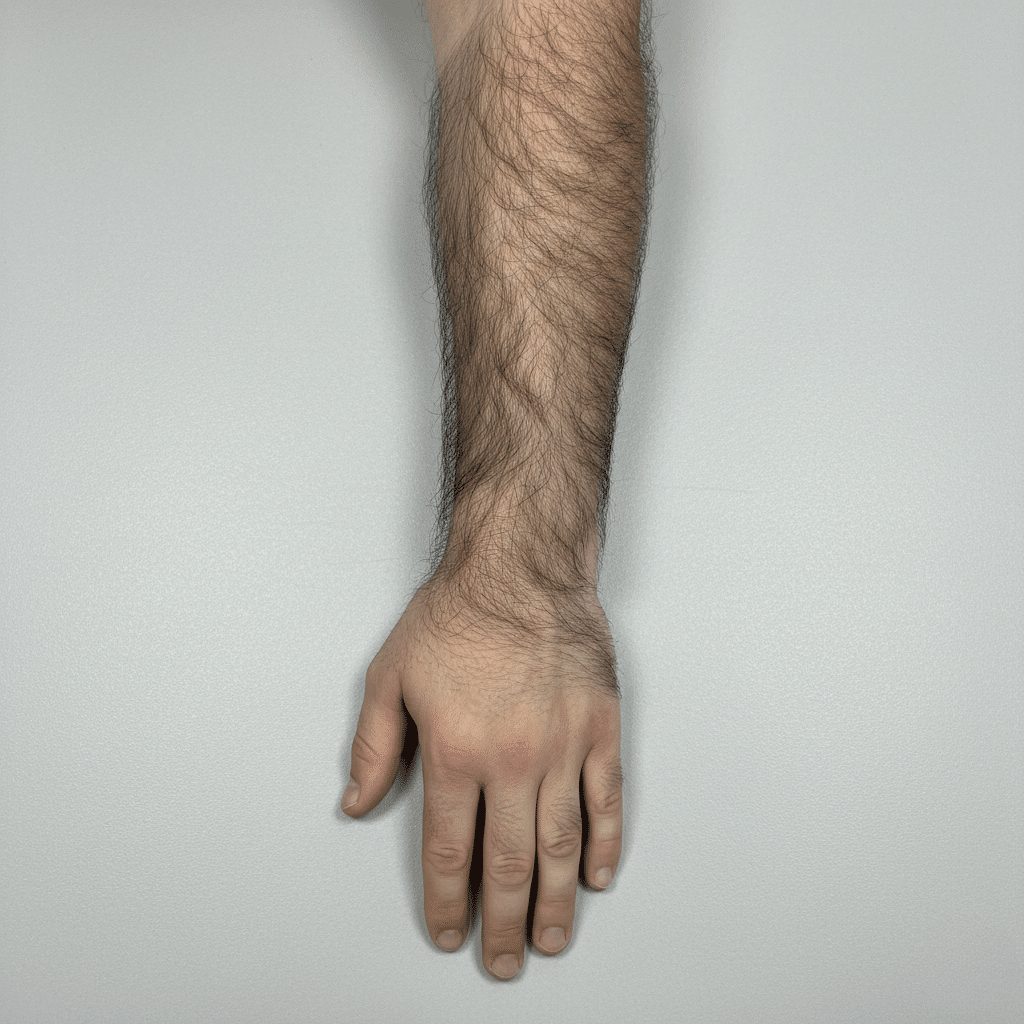
Hypertrichosis vs. hirsutism: the key difference
This is the most important distinction to make in order to understand one’s own clinical picture. The two terms, hypertrichosis and hirsutism, are often mistakenly used interchangeably.
| Characteristic | Hypertrichosis | Hirsutism |
|---|---|---|
| Cause | Not androgen-related (e.g. genetic or drug-induced) | Hormonal (excess male hormones) |
| Those affected | Men, women and children | Almost exclusively women |
| Hair type | Mostly fine vellus hair, with some terminal hair as well | Thick, dark terminal hair is essential |
| Distribution patterns | Regardless of the pattern of male hair growth (e.g. all over the body, on the face or on the arms) | Depending on the male pattern of hair growth (e.g. beard, chest, back, inner thighs) |
Forms and causes of hypertrichosis
Medical professionals classify hypertrichosis according to its presentation and cause:
Generalised vs. localised hypertrichosis
In the generalised form, the whole body is affected. The localised form is confined to one or more clearly defined areas of the body.
Congenital vs. acquired hypertrichosis
Congenital: A very rare, genetic condition present from birth. The most severe form is colloquially known as „werewolf syndrome“.
Acquired: This form only develops over the course of a person’s life and is far more common. There can be a variety of causes, but the most common are side effects of medicines (e.g. minoxidil for hair loss, cyclosporine following transplants, phenytoin for epilepsy).
The most important step: the medical diagnosis
Diagnosis by a doctor only
If you notice any unusual or excessive hair growth, it is essential to see your GP or go directly to a dermatologist (skin specialist). The doctor will determine, through a detailed medical history (particularly regarding any medication you are taking), a physical examination and, if necessary, a blood test, whether the condition is hypertrichosis or hirsutism and whether there is an underlying medical condition. Self-diagnosis is neither possible nor advisable in this case.
Treatment options: What really helps
As hypertrichosis, unlike hirsutism, has no hormonal cause, treatment is not aimed at addressing the cause but at removing the unwanted hair.
Temporary methods
Shaving, waxing, plucking or using depilatory creams are short-term solutions.
Long-term methods
For a long-lasting or permanent solution, professional hair removal treatments are an option:
- Laser hair removal: This treatment uses high-energy light to selectively destroy the hair follicle. This method is particularly suitable for dark hair on fair skin and can result in significant and long-lasting hair reduction.
- Needle epilation (electrolysis): With this method, a wafer-thin probe is inserted into each individual hair follicle and the hair root is permanently destroyed by an electrical pulse. It is very time-consuming, but it is the only method that works even on very light, grey or red hair.
Risks and protection through follow-on costs insurance
Professional hair removal is safe when carried out correctly. However, there are risks involved:
Laser hair removal:
- Burns
- Bubble formation
- Pigment changes (light or dark patches)
- temporary redness
- Swelling
Needle epilation:
- Infections
- small scars
- Pigment changes

Should a complication arise following one of these treatments that requires further medical treatment, this could result in significant costs. A policy taken out in advance Consequential Costs Insurance can protect you from these financial burdens.
Frequently Asked Questions (FAQ) on hypertrichosis
Hypertrichosis itself is usually harmless. However, it may be a symptom of another, underlying condition or a side effect of medication, which is why a medical assessment is so important.
Only if the cause can be remedied. For example, if a medication that is triggering the condition is stopped following consultation with a doctor, hair growth may gradually return to normal. Congenital forms are permanent.
An increase in fine vellus hair on the face, particularly in older people, may be a form of acquired hypertrichosis. Here, too, the first step is to seek medical advice.
No. As the cause is not hormonal, hormone therapies are ineffective in cases of hypertrichosis alone. They are used to treat hirsutism.
With depilation (e.g. shaving), only the visible part of the hair is removed. With epilation (e.g. laser, needle epilation, waxing), the hair is removed along with the root.