Split-thickness skin graft: The standard method for covering large skin defects
Split-thickness skin grafting is the standard method for permanently closing large skin defects following burns, accidents or tumour surgery.
Split-thickness skin grafting is one of the most fundamental and important procedures in plastic and reconstructive surgery. As an established standard technique, it is indispensable when it comes to safely and permanently closing large skin defects, such as those resulting from burns, accidents or major tumour operations. This article explains precisely and clearly what a split-thickness skin graft is, how it differs from other types of skin grafts, and what role it plays in modern surgery.
Table of Contents
Important note
This article is for information purposes only and is not a substitute for a medical diagnosis or advice. If you are unsure, or if you require a personalised treatment plan, it is essential that you consult a qualified specialist.
What is a split-thickness skin graft?
A split-thickness skin graft is a surgical procedure in which the patient’s own skin is transplanted to another part of the body to cover a wound. A characteristic feature of split-thickness skin grafting is that only the outermost layer of skin (the epidermis) and the outermost layer of the underlying dermis are removed. The donor site heals on its own, but leaves behind a flat scar which usually remains visible permanently and differs in colour and texture from the surrounding skin.
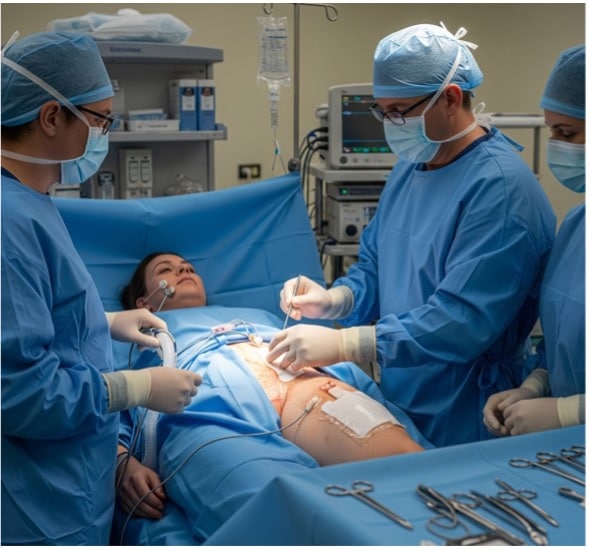
The principle: split hide vs. full hide
To understand split-skin grafting, it is necessary to distinguish it from its counterpart, full-thickness skin grafting. The choice of method depends on the size of the defect and the aesthetic requirements.
| Criterion | Split-thickness skin graft | Full-thickness skin graft |
|---|---|---|
| Layers removed | Epidermis + upper part of the dermis | Epidermis + the entire dermis |
| Thickness | Thin (approx. 0.2–0.5 mm) | Thick (total skin thickness) |
| Application | Extensive defects (e.g. burns) | Small, delicate areas (face, hands) |
| Healing of the puncture site | Sudden, similar to a graze | No spontaneous wound closure, sutures or repositioning of the adjacent skin is required |
| Aesthetic result | Functional; prone to shrinkage and changes in colour | High quality, hardly shrinks at all, better colour and texture |
| Advantage | Capable of covering vast areas | Best aesthetic result |
The procedure for a split-thickness skin graft
The procedure is carried out under general anaesthesia and involves three basic steps:
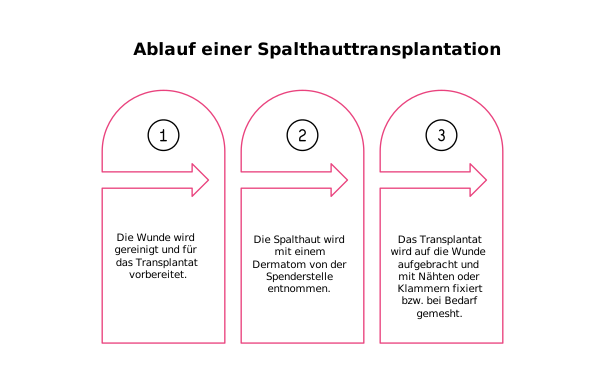
- Preparation of the wound bed Firstly, the wound into which the graft is to be inserted must be clean and well supplied with blood. The surgeon removes all dead or infected tissue.
- Removal of the split skin Using a special surgical instrument, the Dermatom, the split-thickness skin graft is „shaved off“ to the required thickness and size from a suitable donor site (usually the thigh). The donor site is then dressed as if it were a large graze and heals on its own within 10 to 21 days.
- Application and fixing The piece of skin that has been removed is placed over the defect. In order to increase the surface area of the graft and allow wound exudate to drain away, split-thickness skin is often „meshed“, i.e. transformed into a mesh-like structure by making fine incisions (Mesh graft). The graft is then secured with sutures, staples or a special dressing to ensure it remains in firm contact with the wound bed and can heal.
Relevance in Plastic and Aesthetic Surgery
Split-thickness skin grafting is primarily a procedure for skin reconstruction. Its significance in cosmetic surgery lies mainly in the treatment of serious complications following cosmetic procedures.
- Treatment of the most serious complications: In extremely rare cases, cosmetic procedures (e.g. liposuction, abdominoplasty) can lead to severe wound-healing complications or infections (e.g. necrotising fasciitis), resulting in the loss of large areas of skin. In such cases, split-thickness skin grafting is often the only procedure capable of safely closing the resulting defect and saving the patient’s life.
- A mark of the highest level of expertise: Mastery of skin grafting is a core component of training as a plastic and reconstructive surgeon. It demonstrates a doctor’s ability to manage even the most severe and complex tissue defects.
Risks and safeguards for complex procedures
The main risks associated with a split-thickness skin graft are partial or complete loss of the graft (due to infection, bruising or failure to take) and unsightly scarring at both the recipient site and the donor site.
If a skin graft becomes necessary as a result of a complication following cosmetic surgery, this constitutes a complex, medically indicated revision procedure. The costs involved can be immense. A Consequential Costs Insurance is designed to cover the financial costs of precisely such necessary treatment following complications arising from an insured cosmetic procedure.
A split-skin graft differs markedly from normal skin; it is usually less elastic, shows pigmentation changes, and may be shiny or rough in places, whilst the mesh pattern of the mesh graft remains visible. The primary aim is to achieve a functional, stable wound closure.
No. Whilst the puncture site does heal on its own, it leaves a permanent, flat scar that differs in colour and texture from the surrounding skin, much like a healed graze.
The operation itself is carried out under general anaesthetic. During the recovery period, the donor site in particular is often more painful than the graft site, as there are many exposed nerve endings there. This can be effectively managed with appropriate painkillers.
In a skin graft, only the skin is transplanted; this must then be „reconnected“ to the blood supply at the new site. In a flap procedure, a piece of tissue (skin and usually subcutaneous tissue, and occasionally muscle) with its own blood supply is transplanted or repositioned. The composition depends on the type of flap chosen. This is an even more complex procedure for challenging defects.