Sex reassignment and gender-affirming surgery
Gender reassignment is a significant step in the lives of many trans people. Everything you need to know about operations, eligibility criteria, risks, and financial and legal safeguards.

Gender reassignment is a significant step in the lives of many trans people and a subject associated with a great deal of emotion and uncertainty. It is a complex medical procedure that depends on numerous factors, and those affected or their loved ones often have many questions. This article aims to provide comprehensive information whilst explaining the key aspects of the operations, eligibility criteria, risks and aftercare, as well as financial and legal safeguards.
Table of Contents
Important note
This article is for information purposes only and is not a substitute for a medical diagnosis or advice. If you are unsure, or if you require a personalised treatment plan, it is essential that you consult a qualified specialist.
Introduction: Transgender, Gender Affirmation & Gender Dysphoria
What does it mean to be transgender, and why might someone consider having surgery?
The term ‚transgender‘ originally comes from the English-speaking world, but has since found its way into German. Being transgender means that one’s Gender identity not the one assigned at birth biological sex matches.
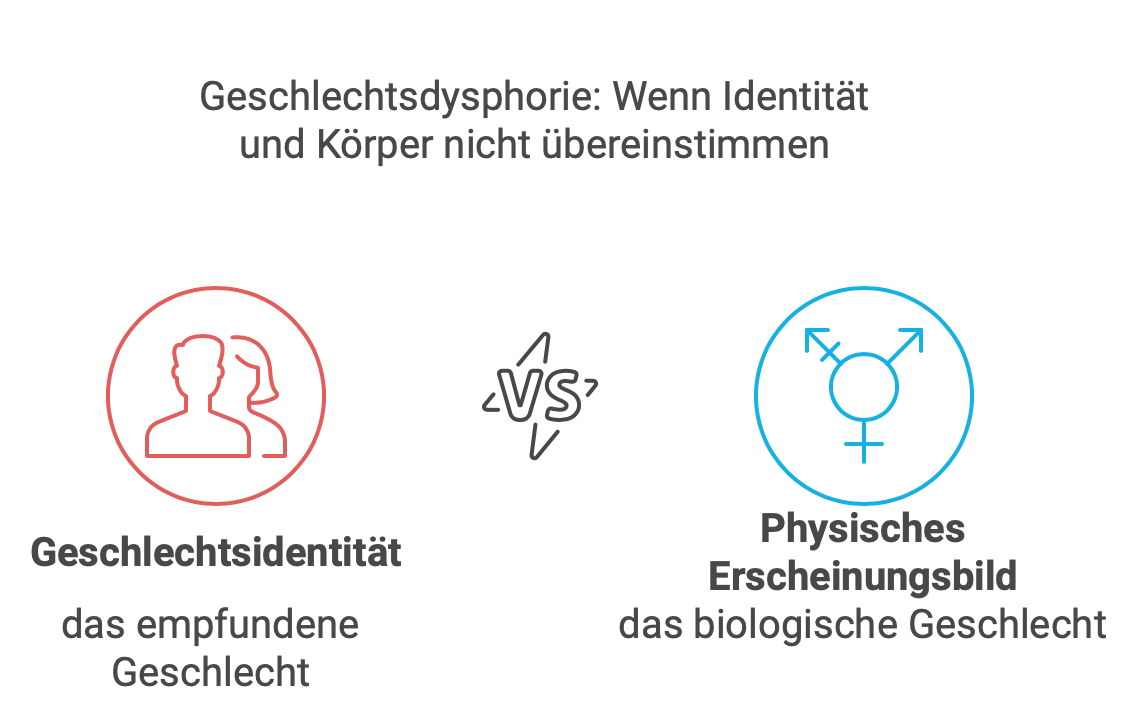
This Discrepancy The discrepancy between gender identity (‚gender‘) and biological sex (‚sex‘) often has severe negative effects on those affected, known as Gender dysphoria. It is not only one’s own dissatisfaction with one’s body or appearance that plays a role here, but also the reactions of those around them, for example through ‚misgendering‘ (referring to the person concerned as the wrong gender). This can lead to both physical and psychological symptoms, ranging from stress and frustration to depression.
In the US, as well as in many other countries, an increasing number of transgender people are therefore opting for a Gender reassignment (‚gender-affirming surgery‘) in order to bring their bodies into alignment with their true identity and improve their quality of life in the long term.
What is gender reassignment?
One Gender reassignment or gender reassignment surgery (GRS) is a surgical procedure in which the body is adapted to a person’s gender identity. This can involve the transformation from male to female physical characteristics (MtF) as well as from female to male (FtM). The procedure often involves the reconstruction of the genitalia as well as other body-modifying measures to align the external appearance with the desired gender identity.
Since when have sex reassignment operations been available?
Historically speaking, gender-affirming surgery has been carried out since the 1930s. One of the best-known early procedures was performed in 1930 on Lili Elbe, a Danish trans woman. The Magnus Hirschfeld Federal Foundation speak of their desire to live in accordance with their gender identity and to share their experiences. Since the 20th century, not only has social acceptance evolved considerably, but so too has medical practice. Nowadays, many specialist clinics offer safe and effective transgender surgeries, tailored to the individual needs of patients to help them express their aspirations and their true identity.
The procedure: How does gender reassignment surgery work?
What actually happens during gender reassignment surgery, what procedures do trans people undergo, and what do patients need to prepare for? In this section, we answer all your questions about the gender confirmation process, what happens after gender confirmation surgery, what to look out for when choosing the right surgeon, as well as any questions regarding costs and the options for having these costs covered by health insurance.
Who is eligible for GAOP? Legal and medical requirements
There are a number of things to bear in mind before undergoing gender reassignment surgery in Germany. Although age does play a role in gender reassignment (the Legal age (assuming this is the case), it is not, however, the only thing that matters in Germany.
As a rule, a formal Diagnosis of gender dysphoria by a psychiatrist or psychotherapist, in order to ensure that the person concerned has felt a deep desire to align with their biological sex over a prolonged period of time.
In addition, patients usually have to wait at least 18 months of psychotherapeutic support have gone through. During this time, their gender identity is clarified and the decision to undergo the procedure is carefully considered.
In most cases, prior to the operation, a Hormone therapy (HRT), which is used to align the body with the desired gender. In male-to-female (MtF) cases, oestrogen is administered to promote the development of female characteristics, whilst in female-to-male (FtM) cases, testosterone is administered to develop male characteristics. This treatment should be carried out at least 6 to 12 months before the operation.
Requirements for gender reassignment surgery:
- Legal age
- Formal diagnosis of gender dysphoria
- Psychotherapeutic support (for at least 18 months)
- Ongoing hormone therapy (at least 6 months)

From man to woman and woman to man: What surgical options are available to transgender people? (Female to Male (FtM))
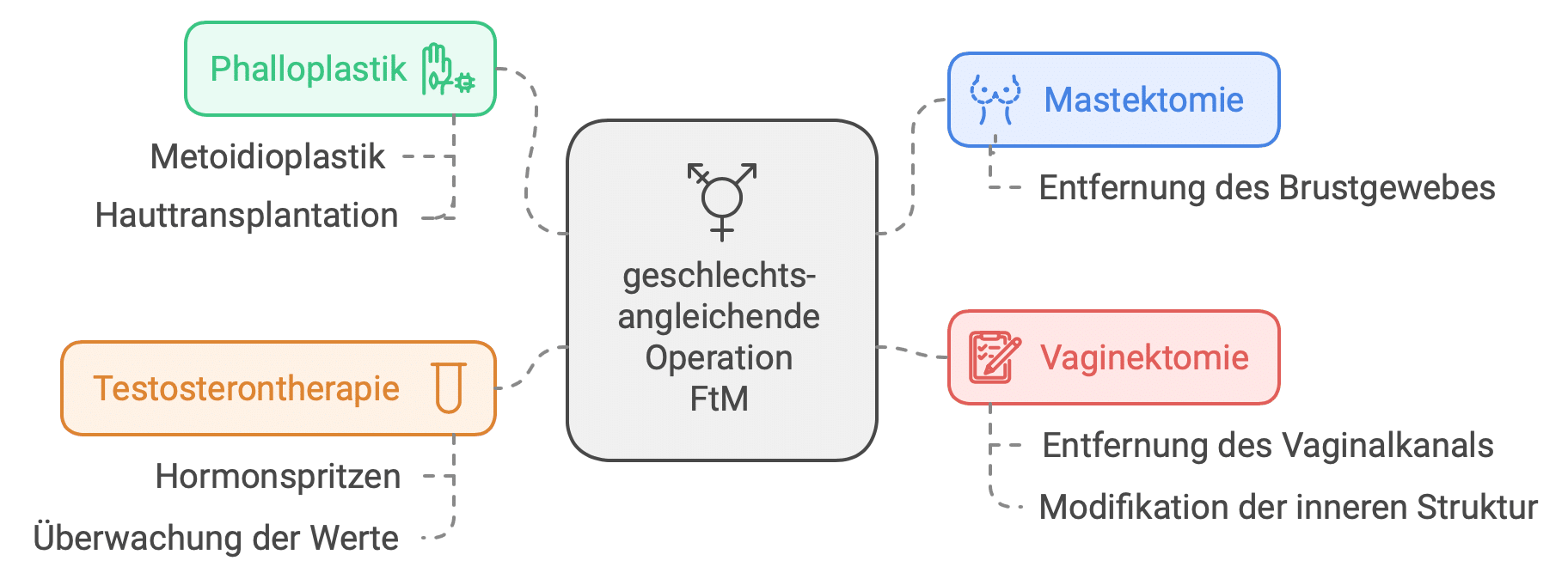
Gender reassignment from female to male is often accompanied by genital reconstruction surgery (penoid), removal of the breasts (mastectomy) and removal of the vagina (vaginectomy), as well as long-term testosterone therapy. The aim is to make the body appear more masculine. Testosterone causes menstruation to stop, changes muscle mass and fat distribution, increases body hair (including beard growth) and deepens the voice.
How does female-to-male gender reassignment work?
In male-to-female gender reassignment, there are several methods for reconstructing the genital area. A common procedure is the Phalloplasty, in which a Penoid (artificial penis) is formed from the patient’s own tissue. In this procedure, tissue is taken for the Skin graft It is often taken from the arm, thigh or abdomen to shape the penis. However, this can result in a scar – for example, on the forearm – as a result of the gender reassignment surgery.
| Advantages | Disadvantages |
|---|---|
| A larger penoid, making it aesthetically and functionally closer to a biological penis. | The operation takes considerably longer and usually requires several procedures. |
| The subsequent fitting of a penile prosthesis enables sexual penetration. | The sensitivity of the penoid is often reduced, as it is formed from transplanted tissue. |
| In most cases, the urethra can be lengthened so that the patient can urinate whilst standing. | Due to the complexity of the operation, the recovery process takes longer than with metoidioplasty. |
An alternative method is the clitoris-penis reconstruction. In this procedure, the clitoris – which has been enlarged by hormone therapy – is used and reshaped into a smaller penis. This technique, also known as metoidioplasty, is less invasive; however, the penis remains smaller than with phalloplasty.
| Advantages | Disadvantages |
|---|---|
| As the procedure is carried out on the enlarged clitoris, sensitivity is largely preserved. | The resulting penis is usually smaller and, for many people, not large enough for penetrative sex. |
| The operation is less complex and takes less time than a phalloplasty. | It is not always possible to lengthen the urethra, so it may not be possible to urinate whilst standing. |
| No large skin grafts from other parts of the body are required, which minimises scarring. |
Complications associated with phalloplasty
Phalloplasty carries a risk of complications such as fistulae (abnormal connections between organs), urethral strictures (narrowing of the urethra), or problems with implants used to achieve erections.
Male to Female (MtF)
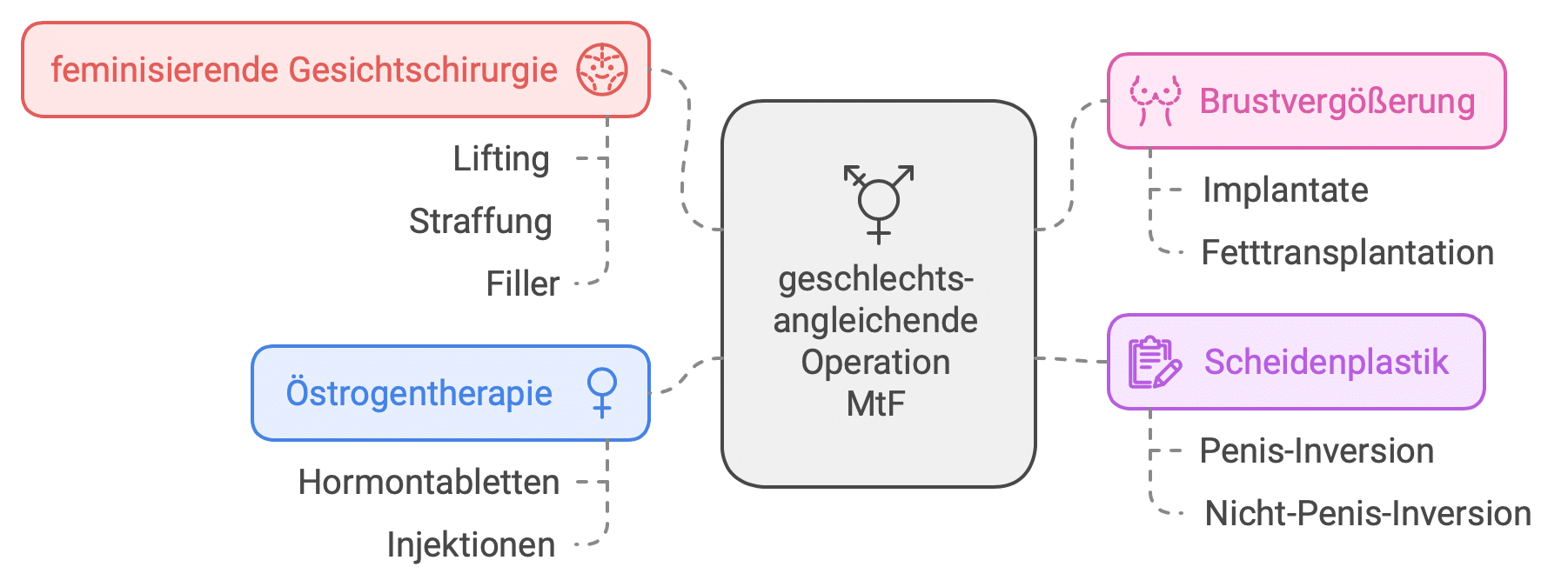
In the case of gender reassignment from male to female, a plastic surgeon can perform the Breast surgery as well as a Vaginal reconstruction (colpoese) a procedure in which an artificial vagina (neovagina) is created from existing body tissue. A distinction is made between the following variants:
The Penile inversion vaginoplasty (PIV) is regarded as the standard procedure. In this procedure, the skin of the penis is turned inside out and used to form the vaginal canal. The glans is often used to form a clitoris, to enable sexual sensation. The labia are formed from other parts of the skin of the penis or scrotum.
| Advantages | Disadvantages |
|---|---|
| Good functional and aesthetic results. | If there is insufficient skin available, the vaginal canal may be shallower. |
| The clitoris may be sensitive. | Regular bougienage (dilation) is necessary to keep the vagina open. |
| A widely used and tried-and-tested method. |
The second option is the Sigmoid colon vaginoplasty. With this technique, part of the Sigmoids (a section of the large intestine) is used to create the vagina. This method is often used when there is not enough skin available from the penis or scrotum.
| Advantages | Disadvantages |
|---|---|
| Enables a deeper vaginal canal. | A more complex surgical procedure with a higher risk of complications, as it involves the bowel. |
| The intestinal lining provides natural lubrication. | Possible post-operative complications, such as infections or scarring. |
Facial feminisation surgery is also frequently carried out, sometimes referred to as ‘combined surgery’ for transgender women, and often includes the following procedures:
- Brow and lip lift, lipofilling
- Jaw and chin correction
- Sanding down the Adam’s apple
- Facelift
- Eyelid surgery
- Reconstruction of the forehead
- Receding hairline
In addition to the Oestrogen therapy There are also some trans women who decide to undertake voice training as well, in order to work on achieving a more feminine or higher-pitched voice.
How does a male-to-female gender reassignment work?
Gender reassignment to become a woman is characterised in particular by the Vaginoplasty in which an artificial vagina is formed from the shaft of the penis. Tissue from the penis and scrotum is used to create a vagina, vulva and clitoris. The urethra is often shortened and the vaginal canal created.
In addition, regular Bougiering necessary following gender reassignment surgery. This involves the insertion of a medical instrument (bougie) to maintain the depth and width of the newly formed vagina after the operation and to keep the tissue supple. Bougie dilation is an essential part of aftercare to prevent the new vagina from narrowing or closing up. Some patients report that this process can be quite painful, which is why regular consultation with a specialist or surgeon may be advisable to prevent injury or inflammation.
Complications associated with vaginoplasty
With penile inversion vaginoplasty, there is a risk that the artificially created vagina may narrow or collapse following genital surgery. Regular bougienage (stretching) is necessary to maintain its shape and function.
Gender reassignment: How long does the procedure take and what are the risks?
Two of the most common questions asked by patients relate to the duration and the associated risks of gender reassignment surgery. In particular, it is important for many people to know how long the recovery periods will be after the procedures, as these may clash with personal commitments and working hours. As gender-affirming surgery often involves several major procedures, thorough and personalised medical advice is essential.
How long does gender reassignment take?
The process of gender reassignment often begins years before the actual operation. This includes the process of self-discovery, which for many trans people can be a stressful and protracted process due to social stigma, as well as undergoing (hormone) therapy, medical care and psychological assessments. The duration of gender-affirming surgery in specialist clinics naturally depends on the type and number of procedures involved. Generally speaking, however, most gender reassignment operations take several hours due to their complexity.
How long do you have to stay in hospital after gender reassignment surgery, and when can you get back to your normal life?
This is a difficult question to which there is no one-size-fits-all answer. According to a Vaginoplasty The hospital stay usually lasts 7 to 10 days. In the case of a Phalloplasty or Metoidioplasty the hospital stay may last between 10 and 14 days take longer, as these procedures are often more complex and involve larger skin grafts.
After being discharged from hospital, it is necessary to stay at home for at least 4 to 6 weeks to take it easy. During this time, physical exertion such as heavy lifting, sport and sexual activity should be avoided.
What risks need to be taken into account in general?
As with all medical and cosmetic procedures, gender-affirming surgery also carries risks. For example, following the operation – whether male-to-female or vice versa – infections, scarring, bleeding and bruising, or even thrombosis and embolism, may occur. Furthermore, transgender surgery may result in a complete or partial loss of sensation in the operated area. This can affect sexual sensation, but also everyday sensations.
Costs, health insurance, insurance schemes: Who pays for gender reassignment?
The cost of gender-affirming surgery is a subject that often causes stress and anxiety for patients. As with other plastic surgery procedures, patients often have to pay for and finance the operations themselves. Depending on the type and complexity of the procedure, operations can cost between 15,000 and 60,000 euros. This is why many people ask: Does health insurance cover gender reassignment surgery?
The answer: Yes, under certain conditions.
- Diagnosis of gender dysphoria by a specialist or psychotherapist
- Long-term treatment to officially confirm trans identity
- A real-life trial lasting at least 12 months, during which the individual is to test living in their intended gender role
- Medically supervised hormone therapy lasting 12 months or longer
- Reports by two independent experts to determine whether gender reassignment is medically necessary
Once these conditions have been met, a Application for reimbursement of costs can be applied for through the health insurance fund. If the application is approved, certain treatments may be covered, for example:
- Costs of psychological support
- Costs for the Hormone therapy
- Costs of surgical procedures (e.g. vaginoplasty, phalloplasty, breast surgery)
- Aftercare and any necessary Corrective surgery
- Cosmetic procedures (e.g. hair removal, vocal cord surgery)

When it comes to gender-affirming surgery, persuading your health insurance provider to cover the costs can be a lengthy and exhausting process. Furthermore, decisions on which treatments and procedures will be covered are made on a case-by-case basis. Patients are therefore advised to seek professional advice in advance to ensure that all the requirements for health insurance-funded transgender surgery are met.
Important note
Every health insurance provider has different procedures and conditions, so it is advisable to contact your health insurance provider at an early stage and submit all the necessary documents. Private health insurance policies may also have different rules.
Insurance cover for gender reassignment and plastic surgery
For people planning gender reassignment surgery, it may be worth taking out a specific insurance policy to cover the procedure. These policies often cover not only the Operation not only on their own, but also potential complications, Follow-up treatments and necessary follow-up procedures. The main advantage of this sort of cover lies in the financial security it provides: particularly in the case of complex procedures such as gender reassignment surgery, unforeseen costs and follow-up treatment may arise which the health insurance provider may not cover and which would be difficult to manage without insurance.
Gender reassignment complete – what happens next?

Post-operative care following gender reassignment surgery
Once gender reassignment has been completed, the phase of Aftercare, which is crucial to long-term success and well-being. Regular medical check-ups are necessary to monitor the healing process and detect any complications at an early stage. The Hormone treatment remains an important part of stabilising physical changes and supporting the desired gender – this is usually continued for life.
Gender reassignment, sex and pregnancy
What sexual activities In this regard, patience is required: depending on how the healing process goes, it will take about 6 to 12 weeks It is possible to gradually resume activities. Furthermore, a Pregnancy for trans men This is possible under certain circumstances, provided the womb has been preserved. In such cases, a doctor should provide comprehensive advice to explain all the options and risks.
In the Gender reassignment from male to A woman is a Pregnancy It is not possible to carry the child to term yourself. If you are hoping to have a child, it is therefore advisable to seek personal advice from a gynaecologist or a specialist counselling service regarding other options, such as surrogacy or adoption.
Where can you have gender reassignment surgery in Germany?
Choosing the right clinic for your first gender-affirming surgery is a crucial step that requires careful consideration. In Germany, there are specialist clinics and surgeons with many years’ experience in this field. To find the right clinic, it is advisable to carry out extensive research and seek recommendations from experienced specialists or counselling centres.
Many turn to networks such as the Trans-Ident e.V. or the Federal Trans Association (BVT), which provide detailed information on clinics and medical care. Specialised advice centres such as the German Society for Transidentity and Intersexuality (dgti), can provide patients with personal support and guidance.
About us: We’ll take care of everything for your procedure
4beauty offers insurance cover for surgical procedures such as cosmetic surgery and medical procedures. Our aim is to ensure that you feel completely at ease and secure on your journey towards your new self. With our cover, we aim to take the financial worries off your shoulders so that you can focus on what matters most – your wellbeing and your recovery. Let us provide you with personalised advice and find out how we can support you as you take your next step.
Contact Contact us for a no-obligation consultation – we’re here to help!
You might also be interested in this
-

Treatments
Tummy Tuck: Everything You Need to Know at a Glance
A toned tummy, a new-found confidence – but which method is right for you, what does the recovery process involve, and what costs can you expect? All the key answers at a glance.
-

Treatments
Eyelid Lift: The Comprehensive Guide
Drooping eyelids can make your eyes look tired. Find out what treatment options are available, what aftercare involves, and what risks and costs you should bear in mind.
-

Treatments
Risks and complications of a breast removal (mastectomy)
For many women, having a breast removed is one of the most life-changing decisions they will ever make. What are the medical risks and consequences of a mastectomy?
-

Risks & Complications
Upper Arm Lift Risks and Complications: The Honest and Comprehensive Guide to Making a Safe Decision
Toned upper arms and greater confidence when wearing sleeveless clothes – but an upper arm lift is not a risk-free procedure. What complications should you be aware of beforehand?
-

Costs & Insurance
How much does cosmetic surgery really cost? Total costs, follow-up costs and financial risks
The price quoted by the surgeon rarely covers the actual costs of cosmetic surgery. Anaesthesia, aftercare and any complications can drive the price up considerably.
-

Preparation & Aftercare
Aftercare following cosmetic surgery: What really matters for healing and results after the procedure
Surgery is only the first step – aftercare determines the final outcome. Here’s what you absolutely must do correctly in the first few weeks.