Aspiration anaesthesia: definition, risks and prevention
Aspiration during anaesthesia is the unintentional entry of stomach contents into the airways whilst the protective reflexes are suppressed by the anaesthetic.
Aspiration anaesthesia:
Aspiration during anaesthesia refers to the unintentional entry of stomach contents or other substances into the airways whilst the natural protective reflexes are suppressed by the anaesthetic. It is considered one of the most feared complications in anaesthesiology and can range from a mild cough to aspiration pneumonia requiring intensive care.
Table of Contents
Important note
This article is for information purposes only and is not a substitute for a medical diagnosis or advice. If you are unsure, or if you require a personalised treatment plan, it is essential that you consult a qualified specialist.
People planning cosmetic surgery rarely think about the risks associated with anaesthesia. Yet aspiration during anaesthesia is one of the complications about which patients should be well informed, as knowing about it protects them and helps them take the right preparatory steps.
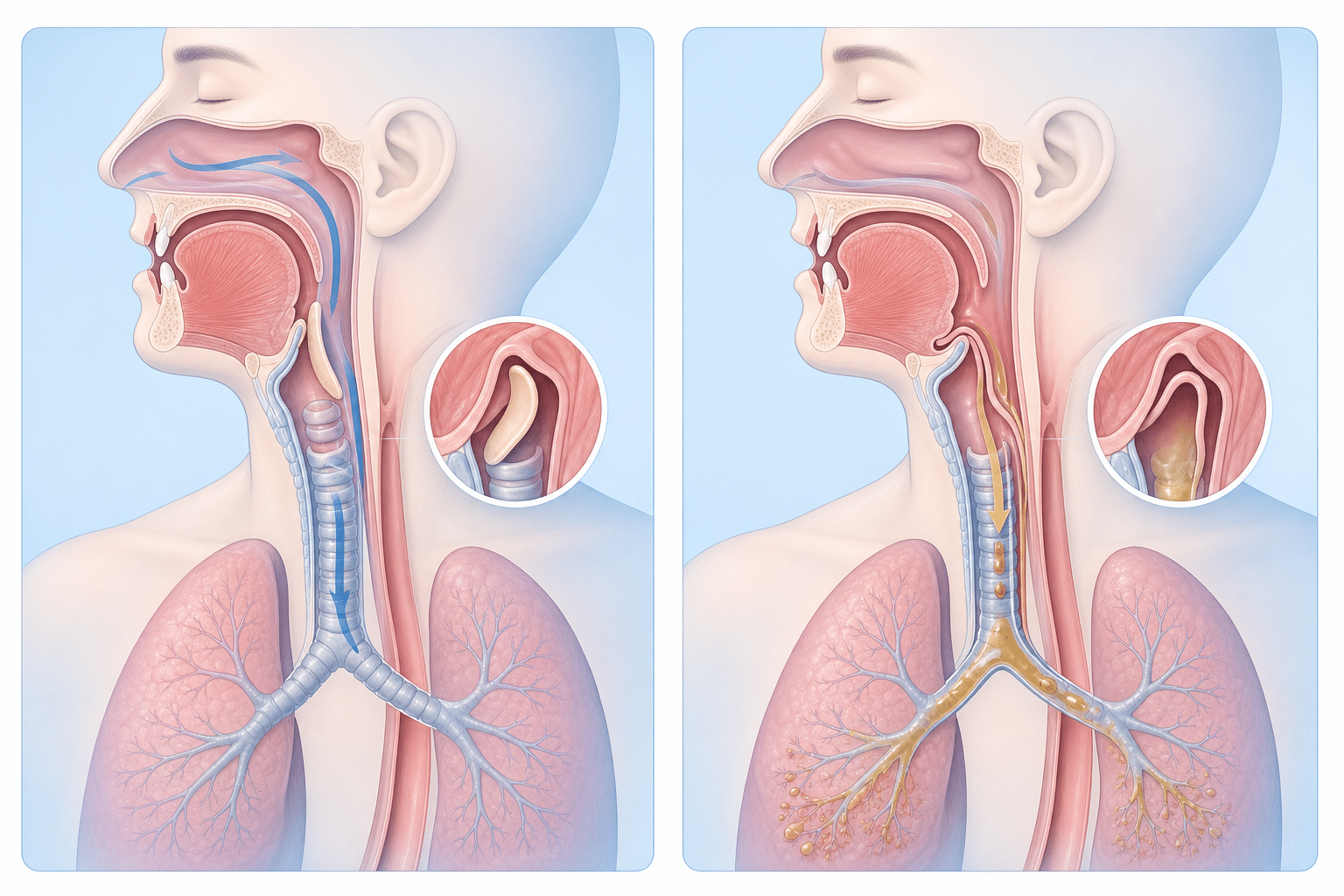
How does aspiration work during anaesthesia?
Key points at a glance
- Under general anaesthesia, the laryngeal reflex, cough reflex and gag reflex are suppressed
- Stomach contents can flow passively into the throat and windpipe
- Food residues mechanically obstruct the airways; acidic gastric juice chemically damages lung tissue
- The most critical phase is the induction of anaesthesia prior to successful intubation
- Severe cases lead to Mendelson’s syndrome (chemical pneumonitis)
Aspiration during anaesthesia occurs because anaesthesia deliberately suppresses the protective reflexes that safeguard the airways whilst a person is awake. Under normal circumstances, the larynx closes in a flash as soon as there is a risk of foreign material entering the airways; anaesthetics deliberately suppress this reflex so that operations can be carried out safely.
The problem arises when there is still stomach contents present at the same time. These can passively empty into the throat and then enter the windpipe and lungs through the open glottis. Solid food particles mechanically obstruct the airways; liquid, acidic gastric juice causes chemical burns to the sensitive lung tissue.
Protective reflexes whilst awake
A healthy body has three coordinated defence mechanisms that prevent the accidental inhalation of stomach contents. The Laryngeal reflex reflexively closes the entrance to the larynx as soon as a foreign substance comes into contact with the mucous membrane. At the same time, the cough reflex emits powerful bursts of exhalation which expel any material that has entered back out. The gag reflex ultimately prevents stomach contents from rising into the throat in the first place.
All three reflexes are affected by anaesthetics in a dose-dependent manner. They may be attenuated even with mild sedation, i.e. before general anaesthesia is administered. This is one of the reasons why fasting guidelines apply even for procedures carried out under twilight sedation or regional anaesthesia with sedation.
Induction of anaesthesia: the critical window
The induction phase of anaesthesia is particularly dangerous. The risk of aspiration is at its highest between the moment consciousness is lost and the moment the airway is secured by intubation, that is, the insertion of a breathing tube into the trachea. The larynx is no longer actively protected, yet the patient cannot yet be ventilated in a controlled manner.
In cases of uncomplicated intubation, this time window lasts just a few seconds. However, if there are anatomical factors that make intubation more difficult – such as a short neck, limited mouth opening or obesity – this critical phase is considerably prolonged. Anaesthetists therefore systematically assess before every procedure whether a difficult airway is present.

Mendelson’s syndrome: when stomach acid damages the lungs
Mendelson’s syndrome is a severe form of aspiration in which acidic gastric juice, with a pH below 2.5, enters the lungs. It was first described in 1946 by the American obstetrician Curtis Mendelson, who observed the complication in obstetric patients under anaesthesia.
Stomach acid causes immediate chemical burns to the lung tissue. The reaction sets in within minutes: the tiny air sacs (alveoli) swell, fluid leaks from the blood vessels, and gas exchange is severely impaired. This presentation resembles acute pulmonary oedema and requires intensive care.
Two factors are crucial in determining the extent of the damage: the pH of gastric juice (the more acidic, the more aggressive) and that aspirated volumes. According to the available research literature, a pH below 2.5 in a volume of more than 25 ml is considered particularly critical. These thresholds explain why the use of medication to reduce gastric acid production prior to high-risk procedures is part of standard prophylaxis.
Mendelson’s syndrome should not be confused with bacterial aspiration pneumonia, in which bacteria aspirated from the oropharyngeal region cause pneumonia. However, both conditions can occur simultaneously or merge into one another, which makes treatment more complex.
Grades of aspiration during anaesthesia
Aspiration is not a uniform clinical presentation; its clinical course depends heavily on the type and quantity of the aspirated material. From an anaesthesiological perspective, three degrees of severity are distinguished:
Mild
Symptoms: Cough, mild bronchospasm, brief drop in oxygen saturation. Usually self-limiting. History: Rapid recovery without permanent lung damage.
Moderate
Symptoms: Persistent bronchospasm, marked drop in oxygen saturation, rales. History: Inpatient monitoring required, oxygen therapy, and, if necessary, short-term intensive care.
Difficult
Symptoms: Acute respiratory distress syndrome (ARDS), severe hypoxia, circulatory instability. History: Intensive care unit, mechanical ventilation, potentially life-threatening.
Even mild aspiration must not be ignored. Experience has shown that patients who initially have few symptoms may sometimes develop a more severe condition in the hours that follow; for this reason, close monitoring for at least two hours is standard practice following any confirmed or suspected aspiration.
Who is particularly at risk from anaesthesia-related aspiration?
Not every patient is at the same risk of aspiration. According to the S1 Guideline on Aspiration Prevention from the German Society for Anaesthesiology and Intensive Care Medicine (DGAI) The following factors are considered to increase the risk:
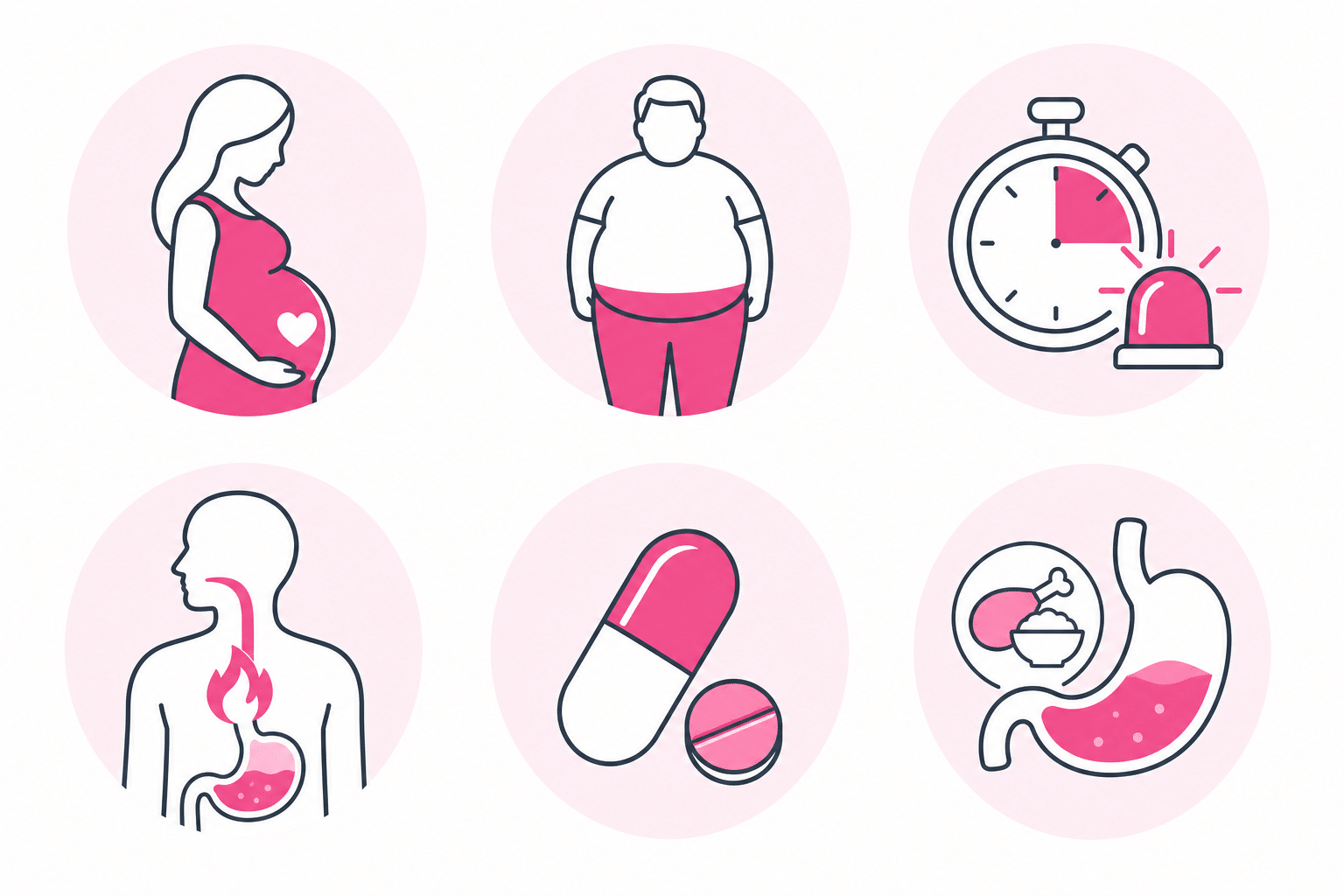
- A full stomach, emergency procedures carried out without the patient having fasted sufficiently
- Pregnancy, increased intra-abdominal pressure, delayed gastric emptying, particularly in the third trimester
- Obesity and gastro-oesophageal reflux, promote the passive reflux of stomach contents into the throat
- GLP-1 receptor agonists (e.g. semaglutide/Ozempic, liraglutide) significantly slow down gastric emptying
- Difficulty breathing, difficult intubation prolongs the critical time window without airway protection
- Urgent or emergency procedures, no possibility of complete sobriety
- Gastroparesis, pathological slowing of gastric emptying, commonly seen in diabetes mellitus
- Oesophageal disorders, e.g. achalasia or hiatal hernia with reflux
For patients:
Please discuss all relevant pre-existing conditions and medications openly during the pre-operative consultation. The anaesthesia team can then tailor the anaesthetic procedure accordingly, for example by using rapid sequence induction or additional prophylactic medication.
GLP-1 medicines as a newly recognised risk factor during anaesthesia
GLP-1 receptor agonists, which include active substances such as semaglutide (Ozempic, Wegovy) and liraglutide (Victoza, Saxenda), are increasingly being used to treat type 2 diabetes and obesity. One of their mechanisms of action is the slowing of gastric emptying (gastroparesis). It is precisely this effect that makes them a risk factor during anaesthesia.
Clinical reports, which have been published more frequently since 2023, show that patients on GLP-1 therapy may still have significant amounts of undigested food in their stomachs, despite having correctly observed fasting periods. The risk of aspiration is therefore higher than in people not taking this medication, even during elective procedures.
Several professional bodies have responded to this. The European Society of Anaesthesiology and Intensive Care (ESAIC) recommends discontinuing GLP-1 agonists in a staggered manner prior to elective procedures: at least one week in advance for weekly dosing, and at least one day in advance for daily dosing. The exact duration depends on the specific medicine and the dosage and should always be determined in consultation with the treating doctor.
Important:
Never stop taking GLP-1 medicines on your own initiative. Discuss stopping the medicines with your doctor and the anaesthesia team, particularly if the medicines are being used to manage your diabetes.
Aspiration prevention: an overview of fasting guidelines
Aspiration prophylaxis refers to all measures taken to reduce the risk of aspiration before and during anaesthesia. The most important and, at the same time, simplest measure is the pre-operative fasting. According to the DGAI guidelines, the following minimum waiting times apply to adult patients undergoing elective procedures:
| What should not be taken? | Minimum waiting time before anaesthesia | Note |
|---|---|---|
| Solid food of any kind | 6 hours | Even easily digestible foods such as toast |
| Milk and milk-based drinks | 6 hours | In anaesthesiology, milk is considered to be a solid food |
| Clear liquids (water, tea without milk) | 2 hours | Drinking up to 2 hours beforehand is expressly permitted |
| Chewing gum, sweets, tobacco | 2 hours | Stimulate the secretion of gastric juices |
| Alcohol | At least 24 hours | Slows gastric emptying; affects the action of anaesthetics |
A common misconception: many patients believe they must avoid fluids altogether. This is incorrect; drinking plain water or unsweetened tea up to two hours before anaesthesia is not only permitted but also recommended. Adequate fluid intake reduces the risk of complications from anaesthesia caused by dehydration.
Pharmacological measures for the prevention of aspiration
In addition to fasting, there are pharmacological measures available for use in cases of increased risk. Shortly before the operation, the anaesthesia team can administer medication to raise the pH level of gastric juice, thereby making any potential aspiration less damaging to the lung tissue.
- H2 blockers (e.g. ranitidine) and proton pump inhibitors (e.g. omeprazole) reduce gastric acid production. They are used pre-operatively in high-risk patients.
- Sodium citrate is a non-particulate antacid that rapidly raises the pH of gastric juice. It takes effect within a few minutes and is administered shortly before anaesthesia is induced; it is standard practice, particularly in obstetrics.
- Metoclopramide accelerates gastric emptying and reduces the residual gastric volume. However, its use is now more selective than it used to be.
The most appropriate combination depends on the individual’s risk profile. There is no standard formula; the decision is made by the anaesthesia team during the pre-operative consultation.
Rapid Sequence Induction: Anaesthetic protection during the critical phase
Rapid Sequence Induction (RSI), also known in German as „Blitzeinleitung“ or „Crasheinleitung“, is a specialised anaesthetic induction technique that minimises the time spent without airway protection. It is the most important anaesthetic tool for preventing aspiration in high-risk patients.
The RSI procedure differs from the standard induction in two key respects: Firstly, all drugs are administered in rapid succession, so that the patient loses consciousness more quickly and the airway can be secured more rapidly. Secondly, interim ventilation with a face mask is generally omitted, as this would force air into the stomach and increase the risk of aspiration.
In addition, the anaesthetist may use the so-called Sellik handle Application: This involves applying external pressure to the cricoid cartilage of the larynx in order to mechanically close off the oesophagus and thus prevent the reflux of stomach contents. The evidence regarding this manoeuvre is the subject of controversy in the specialist literature; many hospitals continue to use it, whilst others have removed it from their protocols.
Symptoms and treatment of aspiration during anaesthesia
Key points at a glance
- Typical symptoms: sudden cough, bronchospasm, drop in oxygen saturation below 95 %
- A chest X-ray and blood gas analysis confirm the diagnosis
- Emergency measure: endotracheal suctioning of the aspirated material
- In severe cases: mechanical ventilation in the intensive care unit
- Antibiotics should only be used to treat secondary bacterial infections, not as a preventative measure
Aspiration under anaesthesia is often only noticed during suctioning after intubation, when anaesthesia staff observe gastric contents in the endotracheal tube, or due to a sudden drop in oxygen saturation during the procedure. Sometimes signs only become apparent postoperatively: coughing, rapid breathing or a fever in the hours following the operation may indicate that aspiration has occurred.

How is aspiration diagnosed?
The diagnosis of aspiration during anaesthesia is based on a combination of several findings. Clinically, the main finding is a drop in oxygen saturation. A chest X-ray shows, depending on the severity and timing, streaky infiltrates or opacities, typically in the lower lobes of the lungs. Arterial blood gas analysis directly measures the extent to which gas exchange is impaired.
A bronchoscopic examination, in which a thin camera system is guided through the airways, not only enables diagnosis but also the targeted removal of foreign material from the bronchi. It is used primarily in severe cases involving particulate aspiration.
Treatment: What happens after aspiration?
Treatment depends on the severity of the condition. In cases of mild aspiration, positioning the patient with the upper body slightly raised, oxygen therapy and monitoring are often sufficient. Severe cases require transfer to an intensive care unit with mechanical ventilation.
A common misconception concerns the use of antibiotics. These are not automatically indicated in cases of aspiration; they are only used once a secondary bacterial infection has been confirmed. Corticosteroids, which were previously used routinely, are also not considered standard treatment for chemical aspiration pneumonitis according to current medical knowledge.
Bronchial lavage, the flushing of the airways with saline solution, is used in cases involving large solid foreign bodies. It is of little use in cases of aspiration of liquid gastric acid, as the acid reacts within seconds and flushing is no longer able to neutralise it.
Financial protection in the event of anaesthetic complications following cosmetic surgery
In severe cases, aspiration under anaesthesia may require a stay in intensive care lasting several days. Ventilator support, bronchoscopy and in-hospital monitoring incur considerable costs. In the case of purely cosmetic procedures that are paid for privately, statutory health insurance often does not cover such consequential costs or demands reimbursement.
Genau für diesen Fall bietet 4beauty eine Insurance cover for the costs arising from cosmetic procedures . It covers medically necessary treatment arising as a result of the insured procedure, including hospital stays, and thus protects against financial burdens that would otherwise have to be borne entirely by the patient.
You can find an overview of all the treatments covered at Treatments & Procedures. Anyone planning to have liposuction or a nose job – both of which are procedures carried out under general anaesthetic – should take out insurance before their operation date; cover can still be arranged up to 24 hours before the procedure.
None
Frequently Asked Questions about Aspiration Anaesthesia
Aspiration during anaesthesia refers to the accidental entry of stomach contents into the airways whilst a patient is under general anaesthesia. Because protective reflexes, such as the laryngeal reflex, are suppressed under anaesthesia, stomach contents can enter the trachea and lungs unimpeded. Depending on the volume and composition, this can lead to anything from a mild cough to life-threatening aspiration pneumonia.
Aspiration is dangerous because the contents of the stomach damage the delicate lung tissue in two ways: solid food particles mechanically obstruct the airways and can lead to suffocation. Acidic gastric juice (pH below 2.5) causes chemical burns to the lungs, known as Mendelson’s syndrome. Severe cases develop acute respiratory distress syndrome (ARDS), which requires treatment in an intensive care unit.
According to the DGAI guidelines: no solid food for at least 6 hours, no milk for at least 6 hours, and no clear liquids such as water or unsweetened tea for at least 2 hours. Drinking plain water up to two hours before the procedure is not only permitted but also recommended. Anyone taking GLP-1 medication should discuss these timeframes separately with the anaesthesia team, as these active substances slow down gastric emptying.
Rapid Sequence Induction (RSI) is a specialised anaesthetic induction technique in which all drugs are administered in rapid succession to keep the period without airway protection as short as possible. Intermittent ventilation using a face mask is not used. RSI is used in patients at increased risk of aspiration, such as emergency patients who have not fasted, pregnant women or those with severe reflux.
Yes. GLP-1 receptor agonists such as semaglutide (Ozempic, Wegovy) significantly slow down gastric emptying. Clinical reports show that patients taking this medication may still have significant gastric contents despite having observed fasting periods. Several professional bodies therefore recommend discontinuing GLP-1 preparations some time before elective procedures. The exact duration should be agreed on a case-by-case basis with the treating doctor and the anaesthesia team.
Fasting periods prior to elective anaesthesia in accordance with the current DGAI guidelines (as at July 2026). The information applies to healthy adults undergoing elective procedures. Any individual variations must be agreed with the anaesthesia team.