Anaesthesia Information Sheet
The pre-anaesthesia consultation is the discussion with the anaesthetist prior to the procedure, during which the patient’s personal safety profile is drawn up.
The decision to have an operation has been made, and the date has been set. However, before the actual procedure takes place, there is one crucial step that is of the utmost importance for your safety: the Anaesthesia Information Sheet. This consultation with the anaesthetist is much more than just a formality. It is the moment when your personal safety profile for the operation is drawn up.
This article explains what to expect during the pre-anaesthetic consultation, why your honest answers are so important, and how you can best prepare yourself so that you can go into your operation feeling confident.
Table of Contents
Important note
This article is for information purposes only and is not a substitute for a medical diagnosis or advice. If you are unsure, or if you require a personalised treatment plan, it is essential that you consult a qualified specialist.

Definition: What is pre-anaesthetic counselling?
The Anaesthesia Information Sheet, also known as a pre-anaesthetic consultation, is the consultation between you and the anaesthetist responsible for your care prior to an operation.
The consultation serves three main purposes: 1. to take your medical history (anamnesis) for the purpose of risk assessment, 2. to select the safest anaesthetic procedure for you, and 3. to provide you with the legally required information about the procedure and its risks.
The anaesthetist: your personal guardian angel during the operation
Many patients focus on the surgeon, but the anaesthetist is your „guardian“ throughout the entire operation. They are responsible for constantly monitoring your vital signs (heart rate, blood pressure, breathing, body temperature) and keeping them stable.
The preliminary consultation forms the basis of his work: this is where he gets to know you and your specific health circumstances, so that he can tailor the anaesthesia perfectly to your needs.
How the interview works: What will be discussed?
The conversation usually follows a clear structure:
- Medical history: Using a questionnaire and through a face-to-face consultation, the doctor will take a detailed history of your health: pre-existing conditions, allergies, previous operations and anaesthesia, medication you are taking, and lifestyle habits (smoking, alcohol).
- Study: The doctor will carry out a brief physical examination, for example by listening to your heart and lungs.
- Choice of procedure: Depending on the planned procedure and your medical history, the most suitable anaesthetic technique will be selected (e.g. General anaesthesia, twilight sleep, regional anaesthesia) are selected and explained.
- Risk information: The doctor will explain the general and specific risks associated with the chosen procedure (e.g. post-operative nausea, hoarseness, rare serious complications).
- Rules of conduct: You will be given clear instructions, particularly regarding the requirement to fast (from what time you must stop eating and drinking).
Your role: Why openness is crucial
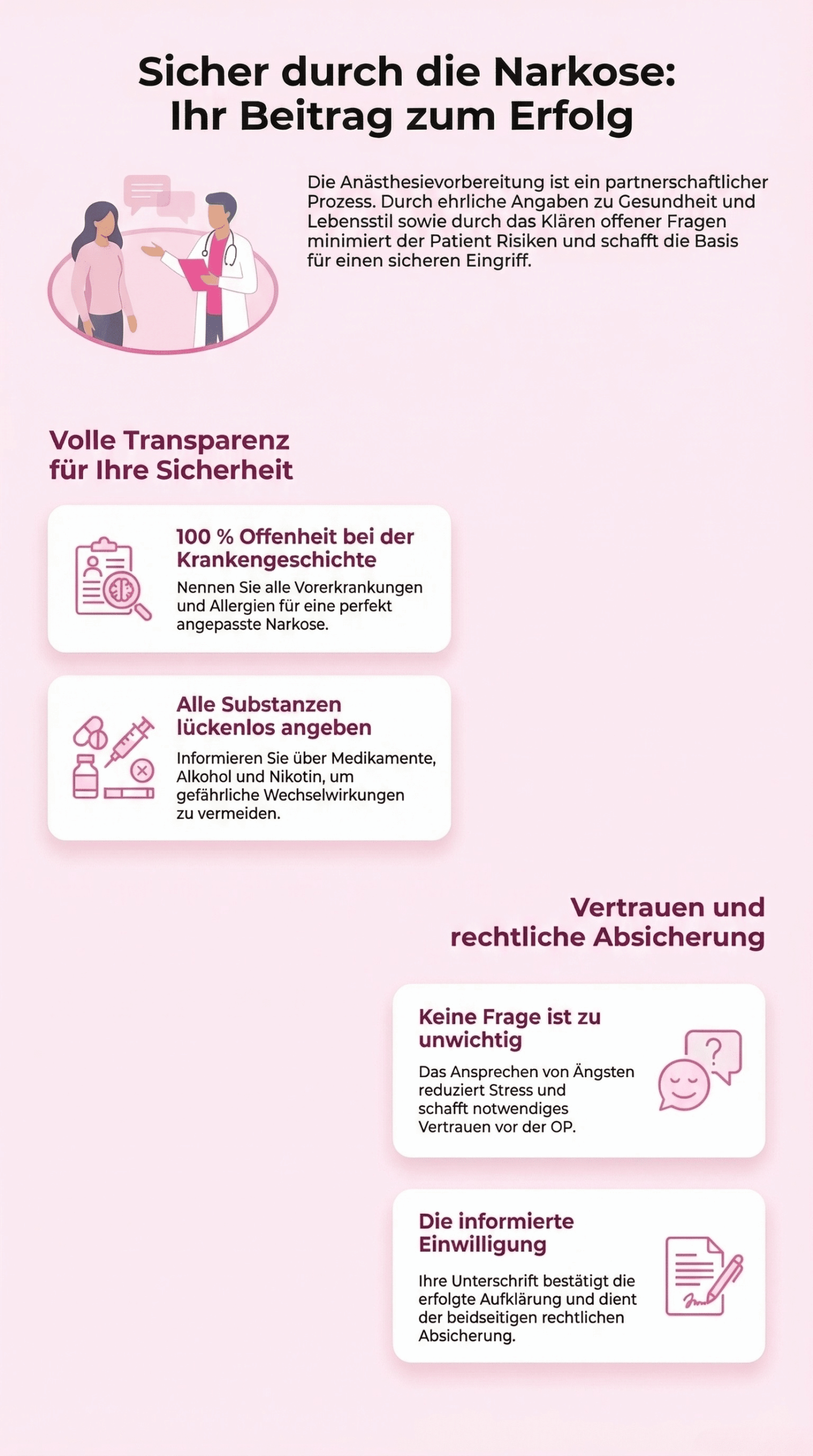
Their most important task is to, 100 % honestly . Do not keep anything to yourself out of shame or fear.
- Are you taking any medicines, including herbal remedies?
- Do you regularly use drugs, alcohol or nicotine?
- Have you or any members of your family ever had any problems with anaesthesia? All of this information is crucial for the anaesthetist to avoid interactions and to manage the anaesthesia safely.
The legal significance: informed consent
At the end of the consultation, you will sign a consent form. By doing so, you confirm that you have been informed about the procedure and the risks involved, and that you consent to the procedure. This document is a legal requirement and protects both you and the medical team.
Risks associated with anaesthesia and financial protection
Modern anaesthetic procedures are extremely safe. Nevertheless, there are residual risks, ranging from common but harmless side effects (such as nausea or a sore throat) to very rare but serious complications (e.g. allergic reactions, cardiovascular problems, nerve damage).
What happens if a complication arises?
If a complication arises following cosmetic surgery that requires further medical treatment, this can result in high costs, which are often not covered by health insurance. A policy taken out before the operation Consequential Costs Insurance provides important financial protection here.
Checklist: How to prepare as effectively as possible
- Medical history form: Please complete the questionnaire you have been given carefully and at your leisure at home.
- List of medicines: Draw up a complete list of all the medicines you are taking (including the dosage).
- Medical reports: Please bring any relevant medical reports or test results (e.g. from a cardiologist) with you.
- Make a note of your questions: Write down any questions you have about anaesthesia. There’s no such thing as a silly question!
- Support person: If you feel unsure, bring someone you trust along to the meeting.
Frequently Asked Questions (FAQ)
Usually the day before or on the day of the operation, and sometimes a few days beforehand – the exact timing depends on the hospital and the procedure.
Inform the anaesthetist immediately. An acute respiratory infection may increase the risks associated with anaesthesia and lead to the operation being postponed.
Talk openly about this fear during your consultation. The anaesthetist can explain the procedures to you in detail and prescribe a sedative (premedication) for you the evening before the operation.
During anaesthesia, your protective reflexes (such as the swallowing reflex) are temporarily suspended. If stomach contents enter the lungs, this can lead to life-threatening pneumonia. The requirement to fast is one of the most important safety rules.